

Malaysian football has never lacked passion. It has never lacked fans, debate, noise, hope or emotional investment. What it has lacked, far too often, is a system strong enough to carry that passion in the right direction.
That is why the recent AFC-FIFA audit findings on the Football Association of Malaysia should not be treated as just another administrative football story. This is not merely about constitution amendments, election structure, voting rights or who gets a seat at the table. It is about something much bigger: whether the national football body has the internal strength, discipline and professionalism to lead Malaysian football into a more modern era.
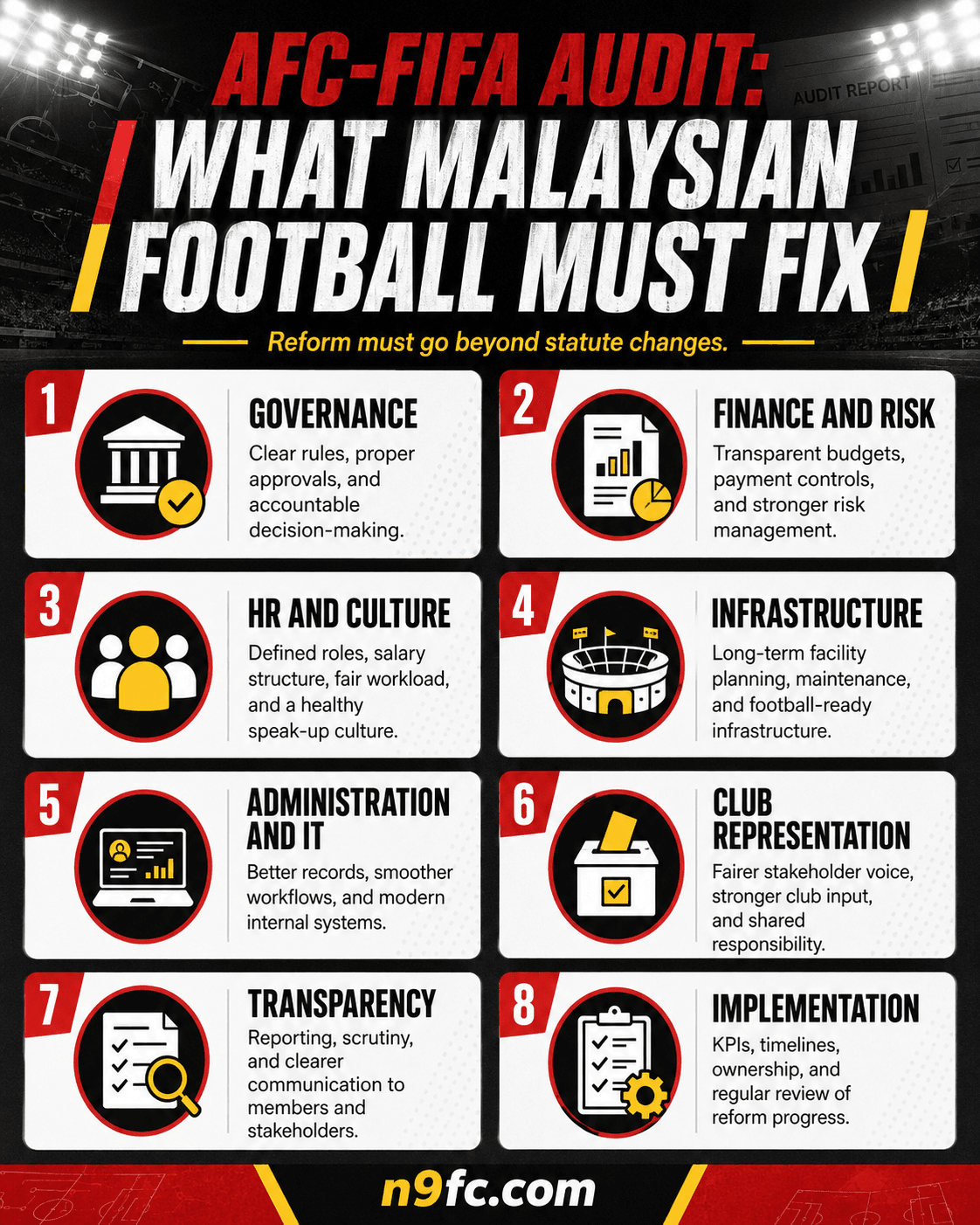
The reported audit findings are uncomfortable. They point towards weaknesses in governance, finance, business information, risk management, human resources, infrastructure, facilities, administration and internal processes. These are not minor details hidden in the background. These are the foundations of any serious football institution.
A national football association is not just a symbolic body. It is supposed to provide leadership, structure, direction and credibility. When the centre is weak, the effects spread across the entire football ecosystem — from professional clubs to youth development, from refereeing to competition planning, from national team preparation to long-term football policy.
That is why the latest reform process cannot be reduced to one simple question: “Has the statute been amended?”
The better question is this: will Malaysian football finally build a system that works?
A Serious Warning About The State Of Football Administration
The most important part of the audit is not the headline number or the political drama around the Extraordinary Congress. The real issue is the pattern of weakness reportedly found across key areas of FAM’s operations.
When an organisation scores poorly in governance, finance, HR and infrastructure, it usually means the problem is not isolated. It is not about one department having a bad year. It suggests that the organisation has been operating without enough structure, measurement and accountability.
That matters because modern football is no longer run by passion alone.
A serious football body needs clear budgeting, legal compliance, risk controls, professional staffing, department-level planning, performance indicators, transparent reporting and a chain of command that everyone understands. Without those things, even good people inside the system will struggle to perform.
This is where Malaysian football must be honest with itself.
For years, fans have often focused on what happens on the pitch: poor finishing, tactical mistakes, weak defending, bad recruitment, inconsistent refereeing, disappointing national team results or clubs struggling financially. Those are visible problems. But many visible problems start from invisible weaknesses.
Poor governance creates poor planning. Poor planning creates poor execution. Poor execution eventually appears on the pitch.
Football failure is rarely just a football problem. It is usually an organisational problem first.
Statute Reform Is Necessary, But It Is Only The Beginning
The approval of AFC-proposed statute amendments is an important development. It suggests that FAM and its affiliates recognise the need for structural change. That cannot be dismissed.
If the new framework creates clearer representation, better governance, stronger club involvement and more modern decision-making, then it is a necessary step forward. Malaysian football has long needed a governance model that reflects the realities of the modern game.
Professional clubs matter. League structures matter. Commercial sustainability matters. Women’s football, futsal, players, referees and technical stakeholders matter. Football administration cannot remain trapped in an old structure while the game around it becomes more complex.
But statute reform has one major limitation: it only changes the rules on paper.
A new constitution does not automatically create transparency. It does not automatically make departments more competent. It does not automatically produce better budgets. It does not automatically protect staff from poor management. It does not automatically improve facilities. It does not automatically make decision-makers more accountable.
This is the danger of “paper reform”.
Many organisations go through reform exercises that look impressive from the outside. New committees are created. New titles are introduced. New voting structures are approved. New documents are circulated. Everyone calls it a reset.
But after a few months, the old habits return.
Decisions are still made informally. Meetings still become ceremonial. Budgets still lack clarity. KPIs exist but are not enforced. Departments are still dependent on a few individuals. Staff still operate without proper structure. Members still approve decisions without serious scrutiny.
That cannot be allowed to happen here.
If Malaysian football wants real reform, the statute must become the starting point, not the finishing line.
The Real Problem Is Culture, Not Just Structure
One of the most important lessons from this episode is that governance failure is rarely only about rules. It is also about culture.
A football body can have committees, regulations, reporting lines and official procedures. But if the culture does not respect those structures, the system will still fail.
For example, if authority is too concentrated at the top, departments become passive. People wait for instructions instead of taking ownership. If staff are afraid to raise concerns, problems stay hidden until they become bigger. If decision-making is informal, accountability becomes difficult. If budgets are not debated properly, spending discipline weakens. If performance is not measured, underachievement becomes normal.
That is how institutions become slow, reactive and resistant to change.
The uncomfortable truth is that Malaysian football has often operated through personality, influence and relationships more than systems. That approach may work temporarily when strong individuals are in charge. But it is fragile. Once those individuals leave, the organisation loses direction because the system was never strong enough by itself.
Modern football institutions cannot depend on “who knows who” or “who can settle things behind the scenes”.
They need repeatable systems.
The best organisations are not strong because every person inside them is perfect. They are strong because their processes reduce the damage caused by human weakness. A good system forces transparency. It records decisions. It checks budgets. It measures performance. It protects institutional knowledge. It makes succession easier. It gives stakeholders confidence.
That is what Malaysian football should now be aiming for.
Why This Matters To Clubs Like Negeri Sembilan FC
Some fans may ask why a fan-run Negeri Sembilan FC site should care so much about FAM’s governance. The answer is simple: national football governance affects every club.
If FAM is weak, clubs feel it.
Club licensing standards, competition rules, referee development, disciplinary systems, youth football direction, national player pathways, women’s football growth and football infrastructure all depend on the strength of the wider system. No club operates in isolation.
For Negeri Sembilan FC, and for every other Malaysian club, reform at the national level should create a more professional environment. Better governance should mean clearer competition planning. Better financial controls should mean stronger licensing discipline. Better HR systems should mean more professional football administration. Better infrastructure planning should eventually support better facilities. Better stakeholder representation should give clubs a stronger voice.
But clubs must also accept the other side of the argument.
Reform cannot mean simply blaming FAM for everything. Malaysian football’s problems are shared across the ecosystem. State associations, professional clubs, league operators, affiliates, academies and stakeholders all have responsibilities.
If clubs demand a stronger voice, they must also be ready for stronger scrutiny. If clubs want to be treated as serious professional entities, they must operate like serious professional entities. That means better accounts, better governance, better facilities, better youth development and better long-term planning.
A stronger FAM should not protect weak clubs. It should raise standards for everyone.
That is the point of reform.
Voting Rights And Representation Must Be Handled Carefully
One of the major themes in the reported statute changes is representation. This is important because football governance depends heavily on who gets voting power and who gets to influence decisions.
Greater club representation can be positive. In modern football, professional clubs are central to the game. They carry the league product, develop players, build fan communities, employ coaches and staff, and invest in facilities. They should not be treated as secondary voices.
However, representation must be transparent, fair and accountable.
Any automatic position, special pathway or reserved seat must be clearly justified. Reform should not simply move influence from one group to another. If the old system was criticised for being too closed or too concentrated, the new system must avoid creating a different version of the same problem.
This is where Malaysian football must be careful.
Democratisation should mean more scrutiny, not just more seats. It should mean better debate, not faster rubber-stamping. It should mean members understand what they are voting on, not merely approving large packages because external pressure is high.
The fact that major reforms were approved is important. But the health of a football democracy is not measured only by whether everyone eventually agrees. It is also measured by whether people are allowed to question, debate and scrutinise before agreement is reached.
That is not obstruction. That is governance.
What Real Reform Should Look Like
If FAM wants this reform moment to mean something, the next step must be practical implementation.
First, there must be transparent annual budget presentation. Members should know the financial direction of the organisation, spending priorities and major risks. Football development cannot be planned properly if financial planning is vague or poorly communicated.
Second, every department needs proper KPIs. Governance, refereeing, competitions, technical development, finance, communications, women’s football, futsal, grassroots and infrastructure should all have measurable objectives. Without measurement, performance becomes opinion.
Third, FAM needs stronger audit and compliance oversight. Internal reform cannot depend only on internal trust. There must be proper checks, reporting mechanisms and follow-up.
Fourth, HR must be professionalised. Job descriptions, salary structures, workload reviews, reporting lines, promotion pathways and staff protection mechanisms are not luxuries. They are basic requirements for a serious organisation.
Fifth, decision-making authority must be documented. Who approves spending? Who signs off policy? Who reports to whom? What requires Exco approval? What can be handled administratively? These things must be clear.
Sixth, reform progress should be reported. If Malaysian football stakeholders are told that reforms are being implemented, they should also be told whether targets are being met. Silence creates suspicion. Reporting creates trust.
Seventh, clubs and stakeholders must be engaged meaningfully. Players, coaches, referees, clubs, fans, administrators and technical experts all see different parts of the football ecosystem. Reform designed only from the top may miss practical realities on the ground.
None of this is glamorous. It will not excite fans like a new signing or a cup final. But this is the work that separates serious football nations from chaotic ones.
Malaysian Football Needs Institutions, Not Just Moments
Malaysian football has had many moments of hope. Big wins. Exciting players. Good crowds. Strong fan culture. National team momentum. Clubs showing ambition. Youth competitions with promise.
But moments are not enough.
A country progresses when it turns moments into systems. A good tournament run must become better youth development. A strong club season must become stronger league standards. A packed stadium must become better fan engagement and commercial planning. A reform congress must become daily organisational discipline.
That is the challenge now.
The AFC-FIFA audit should be embarrassing, yes. But embarrassment is not always bad. Sometimes it is the shock an organisation needs before it finally accepts the scale of its own problems.
The worst response would be defensiveness. The second-worst response would be superficial compliance. The best response is ownership.
FAM must treat the audit as a hard reset.
Not a public relations problem. Not a temporary crisis. Not an external interference. Not a box-ticking exercise.
A reset.
Conclusion: Approval Is Not Achievement
The approval of statute amendments is a step forward, but it is not the destination. Malaysian football should not celebrate too early.
The true test begins after the congress. It begins when budgets are prepared. When departments set targets. When committees actually function. When staff understand their roles. When clubs are held to higher standards. When decision-makers are required to explain their decisions. When reform progress is reported honestly. When old habits are challenged.
That is where Malaysian football usually struggles.
The AFC-FIFA audit has exposed structural weakness, but it has also created an opportunity. If handled properly, this could become one of the most important reform moments in Malaysian football administration.
But if handled poorly, it will become another familiar story: big announcement, strong headline, little change.
Malaysian football does not need another reform slogan. It needs a working system.
Statute changes can open the door. Only accountability, transparency and professional discipline can move the game through it.