

Tag: fam

AFC-FIFA Audit Exposes FAM’s Structural Weakness: Why Malaysian Football Reform Must Go Beyond Statute Changes

Malaysian football has never lacked passion. It has never lacked fans, debate, noise, hope or emotional investment. What it has lacked, far too often, is a system strong enough to carry that passion in the right direction.

That is why the recent AFC-FIFA audit findings on the Football Association of Malaysia should not be treated as just another administrative football story. This is not merely about constitution amendments, election structure, voting rights or who gets a seat at the table. It is about something much bigger: whether the national football body has the internal strength, discipline and professionalism to lead Malaysian football into a more modern era.

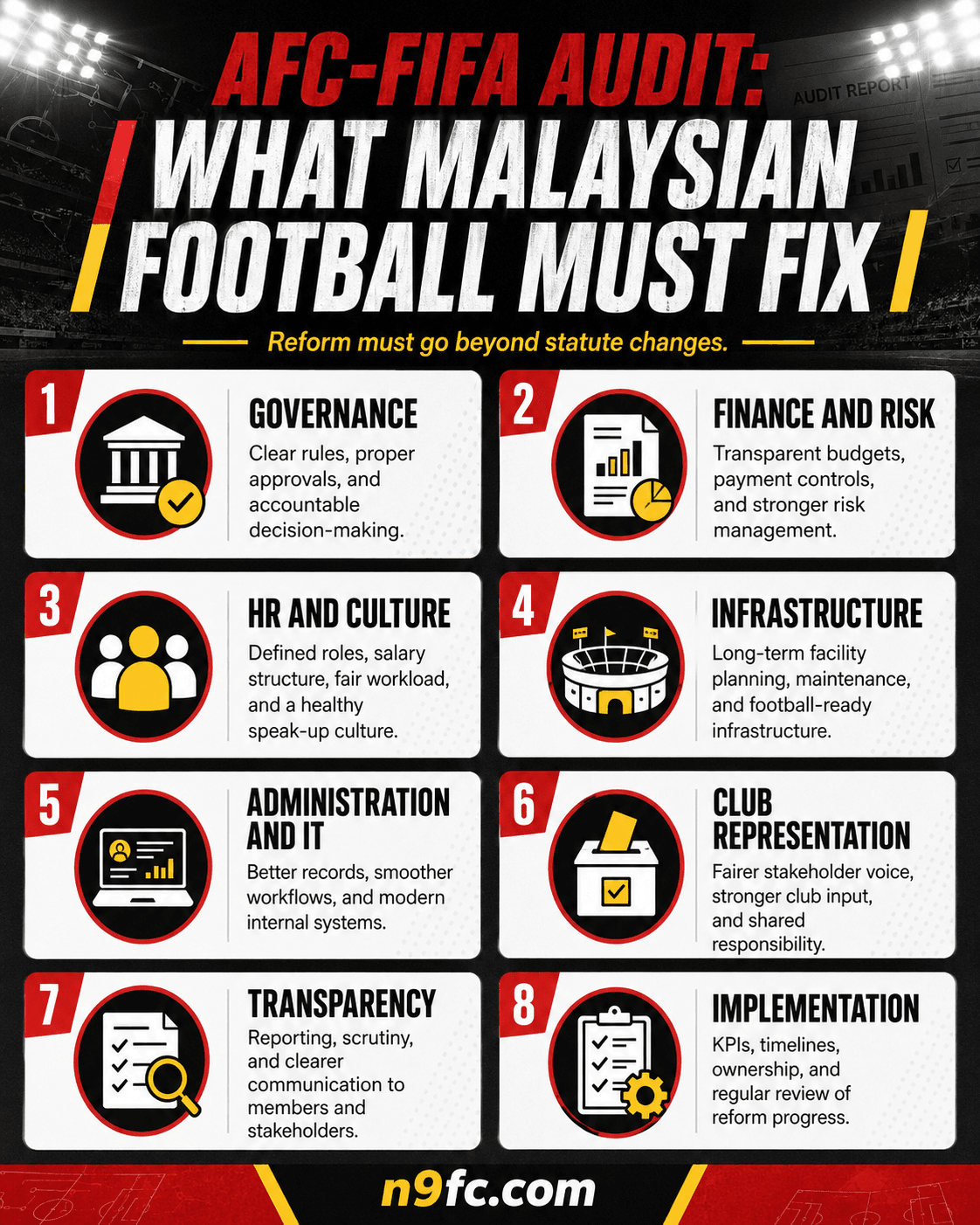
The reported audit findings are uncomfortable. They point towards weaknesses in governance, finance, business information, risk management, human resources, infrastructure, facilities, administration and internal processes. These are not minor details hidden in the background. These are the foundations of any serious football institution.

A national football association is not just a symbolic body. It is supposed to provide leadership, structure, direction and credibility. When the centre is weak, the effects spread across the entire football ecosystem — from professional clubs to youth development, from refereeing to competition planning, from national team preparation to long-term football policy.

That is why the latest reform process cannot be reduced to one simple question: “Has the statute been amended?”

The better question is this: will Malaysian football finally build a system that works?

A Serious Warning About The State Of Football Administration

The most important part of the audit is not the headline number or the political drama around the Extraordinary Congress. The real issue is the pattern of weakness reportedly found across key areas of FAM’s operations.

When an organisation scores poorly in governance, finance, HR and infrastructure, it usually means the problem is not isolated. It is not about one department having a bad year. It suggests that the organisation has been operating without enough structure, measurement and accountability.

That matters because modern football is no longer run by passion alone.

A serious football body needs clear budgeting, legal compliance, risk controls, professional staffing, department-level planning, performance indicators, transparent reporting and a chain of command that everyone understands. Without those things, even good people inside the system will struggle to perform.

This is where Malaysian football must be honest with itself.

For years, fans have often focused on what happens on the pitch: poor finishing, tactical mistakes, weak defending, bad recruitment, inconsistent refereeing, disappointing national team results or clubs struggling financially. Those are visible problems. But many visible problems start from invisible weaknesses.

Poor governance creates poor planning. Poor planning creates poor execution. Poor execution eventually appears on the pitch.

Football failure is rarely just a football problem. It is usually an organisational problem first.

Statute Reform Is Necessary, But It Is Only The Beginning

The approval of AFC-proposed statute amendments is an important development. It suggests that FAM and its affiliates recognise the need for structural change. That cannot be dismissed.

If the new framework creates clearer representation, better governance, stronger club involvement and more modern decision-making, then it is a necessary step forward. Malaysian football has long needed a governance model that reflects the realities of the modern game.

Professional clubs matter. League structures matter. Commercial sustainability matters. Women’s football, futsal, players, referees and technical stakeholders matter. Football administration cannot remain trapped in an old structure while the game around it becomes more complex.

But statute reform has one major limitation: it only changes the rules on paper.

A new constitution does not automatically create transparency. It does not automatically make departments more competent. It does not automatically produce better budgets. It does not automatically protect staff from poor management. It does not automatically improve facilities. It does not automatically make decision-makers more accountable.

This is the danger of “paper reform”.

Many organisations go through reform exercises that look impressive from the outside. New committees are created. New titles are introduced. New voting structures are approved. New documents are circulated. Everyone calls it a reset.

But after a few months, the old habits return.

Decisions are still made informally. Meetings still become ceremonial. Budgets still lack clarity. KPIs exist but are not enforced. Departments are still dependent on a few individuals. Staff still operate without proper structure. Members still approve decisions without serious scrutiny.

That cannot be allowed to happen here.

If Malaysian football wants real reform, the statute must become the starting point, not the finishing line.

The Real Problem Is Culture, Not Just Structure

One of the most important lessons from this episode is that governance failure is rarely only about rules. It is also about culture.

A football body can have committees, regulations, reporting lines and official procedures. But if the culture does not respect those structures, the system will still fail.

For example, if authority is too concentrated at the top, departments become passive. People wait for instructions instead of taking ownership. If staff are afraid to raise concerns, problems stay hidden until they become bigger. If decision-making is informal, accountability becomes difficult. If budgets are not debated properly, spending discipline weakens. If performance is not measured, underachievement becomes normal.

That is how institutions become slow, reactive and resistant to change.

The uncomfortable truth is that Malaysian football has often operated through personality, influence and relationships more than systems. That approach may work temporarily when strong individuals are in charge. But it is fragile. Once those individuals leave, the organisation loses direction because the system was never strong enough by itself.

Modern football institutions cannot depend on “who knows who” or “who can settle things behind the scenes”.

They need repeatable systems.

The best organisations are not strong because every person inside them is perfect. They are strong because their processes reduce the damage caused by human weakness. A good system forces transparency. It records decisions. It checks budgets. It measures performance. It protects institutional knowledge. It makes succession easier. It gives stakeholders confidence.

That is what Malaysian football should now be aiming for.

Why This Matters To Clubs Like Negeri Sembilan FC

Some fans may ask why a fan-run Negeri Sembilan FC site should care so much about FAM’s governance. The answer is simple: national football governance affects every club.

If FAM is weak, clubs feel it.

Club licensing standards, competition rules, referee development, disciplinary systems, youth football direction, national player pathways, women’s football growth and football infrastructure all depend on the strength of the wider system. No club operates in isolation.

For Negeri Sembilan FC, and for every other Malaysian club, reform at the national level should create a more professional environment. Better governance should mean clearer competition planning. Better financial controls should mean stronger licensing discipline. Better HR systems should mean more professional football administration. Better infrastructure planning should eventually support better facilities. Better stakeholder representation should give clubs a stronger voice.

But clubs must also accept the other side of the argument.

Reform cannot mean simply blaming FAM for everything. Malaysian football’s problems are shared across the ecosystem. State associations, professional clubs, league operators, affiliates, academies and stakeholders all have responsibilities.

If clubs demand a stronger voice, they must also be ready for stronger scrutiny. If clubs want to be treated as serious professional entities, they must operate like serious professional entities. That means better accounts, better governance, better facilities, better youth development and better long-term planning.

A stronger FAM should not protect weak clubs. It should raise standards for everyone.

That is the point of reform.

Voting Rights And Representation Must Be Handled Carefully

One of the major themes in the reported statute changes is representation. This is important because football governance depends heavily on who gets voting power and who gets to influence decisions.

Greater club representation can be positive. In modern football, professional clubs are central to the game. They carry the league product, develop players, build fan communities, employ coaches and staff, and invest in facilities. They should not be treated as secondary voices.

However, representation must be transparent, fair and accountable.

Any automatic position, special pathway or reserved seat must be clearly justified. Reform should not simply move influence from one group to another. If the old system was criticised for being too closed or too concentrated, the new system must avoid creating a different version of the same problem.

This is where Malaysian football must be careful.

Democratisation should mean more scrutiny, not just more seats. It should mean better debate, not faster rubber-stamping. It should mean members understand what they are voting on, not merely approving large packages because external pressure is high.

The fact that major reforms were approved is important. But the health of a football democracy is not measured only by whether everyone eventually agrees. It is also measured by whether people are allowed to question, debate and scrutinise before agreement is reached.

That is not obstruction. That is governance.

What Real Reform Should Look Like

If FAM wants this reform moment to mean something, the next step must be practical implementation.

First, there must be transparent annual budget presentation. Members should know the financial direction of the organisation, spending priorities and major risks. Football development cannot be planned properly if financial planning is vague or poorly communicated.

Second, every department needs proper KPIs. Governance, refereeing, competitions, technical development, finance, communications, women’s football, futsal, grassroots and infrastructure should all have measurable objectives. Without measurement, performance becomes opinion.

Third, FAM needs stronger audit and compliance oversight. Internal reform cannot depend only on internal trust. There must be proper checks, reporting mechanisms and follow-up.

Fourth, HR must be professionalised. Job descriptions, salary structures, workload reviews, reporting lines, promotion pathways and staff protection mechanisms are not luxuries. They are basic requirements for a serious organisation.

Fifth, decision-making authority must be documented. Who approves spending? Who signs off policy? Who reports to whom? What requires Exco approval? What can be handled administratively? These things must be clear.

Sixth, reform progress should be reported. If Malaysian football stakeholders are told that reforms are being implemented, they should also be told whether targets are being met. Silence creates suspicion. Reporting creates trust.

Seventh, clubs and stakeholders must be engaged meaningfully. Players, coaches, referees, clubs, fans, administrators and technical experts all see different parts of the football ecosystem. Reform designed only from the top may miss practical realities on the ground.

None of this is glamorous. It will not excite fans like a new signing or a cup final. But this is the work that separates serious football nations from chaotic ones.
Malaysian Football Needs Institutions, Not Just Moments

Malaysian football has had many moments of hope. Big wins. Exciting players. Good crowds. Strong fan culture. National team momentum. Clubs showing ambition. Youth competitions with promise.

But moments are not enough.

A country progresses when it turns moments into systems. A good tournament run must become better youth development. A strong club season must become stronger league standards. A packed stadium must become better fan engagement and commercial planning. A reform congress must become daily organisational discipline.

That is the challenge now.

The AFC-FIFA audit should be embarrassing, yes. But embarrassment is not always bad. Sometimes it is the shock an organisation needs before it finally accepts the scale of its own problems.

The worst response would be defensiveness. The second-worst response would be superficial compliance. The best response is ownership.

FAM must treat the audit as a hard reset.

Not a public relations problem. Not a temporary crisis. Not an external interference. Not a box-ticking exercise.

A reset.

Conclusion: Approval Is Not Achievement

The approval of statute amendments is a step forward, but it is not the destination. Malaysian football should not celebrate too early.

The true test begins after the congress. It begins when budgets are prepared. When departments set targets. When committees actually function. When staff understand their roles. When clubs are held to higher standards. When decision-makers are required to explain their decisions. When reform progress is reported honestly. When old habits are challenged.

That is where Malaysian football usually struggles.

The AFC-FIFA audit has exposed structural weakness, but it has also created an opportunity. If handled properly, this could become one of the most important reform moments in Malaysian football administration.

But if handled poorly, it will become another familiar story: big announcement, strong headline, little change.

Malaysian football does not need another reform slogan. It needs a working system.

Statute changes can open the door. Only accountability, transparency and professional discipline can move the game through it.


Should Citizenship Be Reviewed? FAM Statement Fuels National Debate After CAS Ruling

The Football Association of Malaysia (FAM) has acknowledged the decision delivered by the Court of Arbitration for Sport (CAS) in the high-profile eligibility case involving seven naturalised players, while expressing reservations about the severity of the sanctions imposed.

In a media statement issued on 6 March 2026, FAM confirmed that it had received the operative part of the CAS award concerning appeals filed by both the association and the seven affected players.

Under the ruling, FAM’s appeal was dismissed, while the players’ appeals were partially upheld, leading to an adjustment in the sanctions originally imposed by FIFA. The players will remain barred from participating in official matches for another eight months, although they are permitted to continue training and engaging in football-related activities with their respective clubs.

FAM also noted that the full reasoning behind the CAS decision has not yet been released, and further comments will be made once the complete written award becomes available.

FAM Accepts Administrative Oversight

In its statement, FAM acknowledged oversight failures in the administrative process related to the players’ naturalisation and eligibility documentation. The association confirmed that investigations by Malaysian federal agencies and FIFA are still ongoing, and reiterated its commitment to cooperate fully with all relevant authorities.

The association described the outcome as deeply disappointing, particularly for the players involved. According to FAM, the players were not involved in the administrative preparation of the documents used in the eligibility process and had no knowledge of the matters handled by administrators.

FAM also emphasised that the players had obtained Malaysian citizenship in accordance with Malaysian law, and thanked supporters for their continued backing during what it described as a difficult period for Malaysian football.

A Wider Issue: Sovereignty and Sporting Regulations

Beyond the immediate sporting consequences, the case raises an important question that sits at the intersection of sports governance and national sovereignty.

While FIFA and CAS regulate eligibility rules for international football, citizenship itself is a sovereign matter governed by Malaysian law and the Federal Constitution. In other words, international sporting bodies determine whether a player can represent a national team, but they do not have the authority to grant or revoke nationality.

This creates a complex situation. The players may remain Malaysian citizens under domestic law, yet still be deemed ineligible to represent the national team under FIFA regulations.

From a diplomatic standpoint, FAM’s response can be seen as cautious and measured, acknowledging the CAS ruling while leaving room to review the detailed reasoning of the decision before determining further steps.

Should the Citizenship Be Revoked?

One of the more sensitive questions emerging from the case is whether the Malaysian government should revoke the citizenship granted to the players, particularly if the naturalisation process involved falsified eligibility claims.

From a legal and policy perspective, the answer is not straightforward.

Under Malaysian law, citizenship granted through naturalisation can potentially be revoked if it is proven that the status was obtained through fraud, false representation, or concealment of material facts. If future investigations confirm that the naturalisation process relied on falsified documentation, the government technically has the legal authority to review or withdraw that citizenship.

However, several factors complicate the matter:

  • The CAS ruling itself suggests that the players had limited involvement in preparing the documents, implying that the issue may lie more with administrative processes rather than deliberate deception by the players.
  • Revoking citizenship is an extremely serious action that goes beyond sporting sanctions and would carry diplomatic, legal and reputational consequences.
  • The players have already been sanctioned under football regulations, which may lead policymakers to view the sporting penalties as sufficient.

For these reasons, many observers argue that revoking citizenship would likely be disproportionate unless clear evidence emerges that the players themselves knowingly participated in falsification.

What the Malaysian Government Should Do Next

Rather than focusing solely on punitive measures, the more pressing priority for Malaysia may be institutional reform.

Several steps would help prevent similar controversies in the future:

1. Establish a clear national framework for sports naturalisation
Malaysia needs a transparent policy outlining how athletes may obtain fast-track citizenship and how eligibility requirements align with international federation rules.

2. Strengthen coordination between ministries and sporting bodies
Naturalisation for sporting purposes often involves multiple institutions, including the Home Ministry, immigration authorities and national associations. Clear protocols would reduce the risk of administrative gaps.

3. Implement stronger due-diligence checks before eligibility submissions
Ensuring that documentation submitted to FIFA meets eligibility standards would protect both athletes and national federations from reputational damage.

A Turning Point for Malaysian Football Governance

While the CAS decision offers partial relief by allowing the players to continue training during their suspension, the controversy has exposed systemic weaknesses in how sporting naturalisation was handled.

The case is therefore likely to serve as a turning point for governance in Malaysian football, forcing stakeholders to reconsider how competitive ambition, regulatory compliance and national sovereignty should be balanced moving forward.

For now, the focus remains on awaiting the full CAS written award, which will provide the detailed reasoning behind the ruling and may further shape how Malaysia responds to one of the most significant eligibility disputes in its football history.

FAM Executive Committee Resignation: What It Means for Negeri Sembilan FC and Malaysian Football

The Football Association of Malaysia (FAM) has officially announced that all members of its Executive Committee for the 2025–2029 term have collectively and voluntarily stepped down with immediate effect. The decision was made unanimously, framed as a principled and responsible move to safeguard the integrity, credibility, and long-term interests of Malaysian football.

In its statement, FAM emphasised that the resignation was not driven by personal interest or positions of power, but by organisational accountability amid circumstances that have drawn significant public attention. The move is intended to protect institutional integrity, reinforce good governance, and provide a transparent pathway for external assessment by global and regional football authorities.

A Governance Reset at National Level

According to FAM, the collective resignation serves several key objectives:

  • Preserving the reputation and interests of Malaysian football as a whole
  • Upholding principles of accountability and good governance during a sensitive period
  • Allowing FIFA and the Asian Football Confederation (AFC) the space to independently assess, review, and if necessary, intervene on matters related to governance and administration
  • Ensuring any reforms or corrective measures can be implemented without conflict of interest or public perception issues
  • Restoring confidence among stakeholders, partners, supporters, and the wider football community

Despite stepping down, former Executive Committee members have reiterated their commitment to fully cooperate with FIFA, AFC, and all relevant stakeholders, prioritising the long-term future of Malaysian football over individual mandates.

Implications for Negeri Sembilan FC

For clubs such as Negeri Sembilan FC, the announcement is expected to translate into administrative continuity rather than disruption in the short term.

From an operational perspective:

  • Competitions, licensing, and match calendars are expected to proceed as scheduled under existing frameworks governed by FIFA and AFC regulations.
  • Club autonomy remains intact, with Negeri Sembilan FC continuing to operate under its own professional management structure, technical planning, and commercial strategy.
  • Regulatory clarity and reform, should it emerge from this process, may ultimately benefit clubs through stronger governance standards, clearer compliance mechanisms, and enhanced institutional credibility at national level.

For Negeri Sembilan FC specifically, the situation underscores the importance of the club’s ongoing emphasis on professionalism, long-term planning, and internal governance—values that align closely with the principles highlighted in FAM’s announcement. The club’s continued investment in infrastructure, youth development, coaching education, and high-performance standards positions it well regardless of changes at the national administrative level.

Looking Ahead

While the immediate focus at national level will be on governance review and institutional stability, the broader football ecosystem—including clubs, players, officials, and supporters—stands to benefit from a process that prioritises transparency and trust.

For Negeri Sembilan FC, the message is clear: football operations continue, long-term development remains the priority, and the club’s commitment to sustainable growth and professionalism will remain unchanged. As Malaysian football enters this transitional phase, stability at club level will be a crucial pillar in ensuring the game continues to progress on and off the pitch.

Negeri Sembilan FC fans will continue to monitor developments closely and remain aligned with all directives from the relevant authorities, with the best interests of the club, its supporters, and Malaysian football at heart.

Inside FIFA’s Case Against FAM: What the Independent Investigation Reveals

Below is a detailed summary of the Report of the Independent Investigation Committee (IIC) of the Football Association of Malaysia (FAM) on FIFA’s Case against FAM and Seven Malaysian National Team Players.

1. Background & Purpose of the Investigation

  • On 27 October 2025, FAM appointed Tun Md Raus Sharif, former Chief Justice of Malaysia, as Chairman of an Independent Investigation Committee (IIC).
  • The IIC’s mandate was to investigate FIFA’s disciplinary case involving:
    • FAM, and
    • Seven naturalised players who represented Malaysia.
  • The investigation focused on whether forged or falsified documents were used in FIFA eligibility proceedings.

2. FIFA’s Case Against FAM and the Seven Players

Legal Basis

  • FIFA charged FAM and the players under Article 22 of the FIFA Disciplinary Code 2025, which criminalises:
    • Forging documents,
    • Falsifying authentic documents, or
    • Using forged/falsified documents in football-related matters.

The Seven Players

  • The players were foreign-born (Spain, Argentina, Brazil, Netherlands).
  • They represented Malaysia after obtaining Malaysian citizenship through naturalisation.

3. Timeline of Key Events

  1. Early 2025
    • FAM submitted documents to FIFA via the FIFA Legal Portal to confirm player eligibility.
    • Documents included:
      • Passports,
      • Malaysian citizenship documents,
      • Grandparents’ birth certificates allegedly showing birth in Malaysia,
      • Declarations that players had not represented other national teams.
  2. March–June 2025
    • FIFA responded (27 March, 6 June, 9 June 2025) that the players appeared eligible based on submitted documents.
  3. 10 June 2025
    • All seven players played against Vietnam in the AFC Asian Cup 2027 Qualifiers.
    • Two of the players scored.
  4. 11 June 2025
    • FIFA received a formal complaint questioning the legitimacy of the players’ eligibility.
  5. FIFA Investigation
    • FIFA obtained original birth records of the players’ grandparents.
    • These records contradicted the documents submitted by FAM.

4. Core Findings of FIFA

  • The birthplace information of the grandparents submitted by FAM was false.
  • FIFA concluded:
    • The documents were forged or falsified.
    • The documents were used to circumvent FIFA eligibility rules.
  • Under Article 22(2), FAM was held liable for acts committed by officials or players.

5. FIFA Disciplinary Decision (25 September 2025)

  • FIFA found FAM and all seven players guilty of breaching Article 22.
  • Sanctions imposed:
    • FAM fined CHF 350,000 (CHF 50,000 per player; ≈ RM1.8 million).
    • Match bans and further sanctions imposed on players (per FIFA code).

6. Malaysian Government’s Position on Citizenship

Key Clarifications by the Minister of Home Affairs

  • The seven players:
    • Were lawfully granted Malaysian citizenship under Article 19(2) of the Federal Constitution.
    • Met all legal and constitutional requirements.
  • Documents issued by National Registration Department (NRD) were:
    • Authentic,
    • Not forged,
    • Not part of FIFA’s allegations.

Critical Legal Distinction

  • Citizenship ≠ FIFA eligibility
    • Citizenship is governed by Malaysian sovereign law.
    • Eligibility to represent Malaysia is governed solely by FIFA regulations.

7. IIC’s Position on Citizenship

  • The IIC did not and could not challenge citizenship decisions:
    • Citizenship matters fall exclusively under Malaysian courts and the Federal Government.
  • The IIC confirmed:
    • The players are legally Malaysian citizens.
    • Citizenship alone does not guarantee eligibility to play for the national team.

8. The Forged Documents Issue (Central Problem)

FIFA Eligibility Rule (Article 7)

To represent a country, a player must show at least one genuine link:

  • Birth in the country, or
  • Parent born in the country, or
  • Grandparent born in the country, or
  • Long-term residence.

What Went Wrong

  • The seven players relied on grandparents’ birth certificates.
  • Documents submitted by FAM stated grandparents were born in:
    • Malacca, Penang, Johor, Kuching, etc.
  • FIFA’s investigation proved grandparents were actually born in:
    • Spain, Argentina, Brazil, Netherlands.

➡ This contradiction formed the basis of FIFA’s forgery charge.

9. Responsibility & Evidence Assessment

FAM Administration

  • Legal Manager (Zainul Ariffin):
    • Uploaded documents to FIFA.
    • Acted on instructions of the General Secretary.
  • General Secretary (Datuk Noor Azman):
    • Admitted FAM staff handled and formatted documents.
    • Acknowledged lack of proper verification.
    • Retained ultimate administrative responsibility.

National Team Setup (MNFTS)

  • Led by Rob Friend (CEO).
  • Claimed documents came from players’ agents.
  • No evidence of direct involvement in forgery.

Players

  • All seven players stated:
    • Agents handled documentation.
    • They relied entirely on FAM and agents.
    • They were not aware of document falsification.

Critical Gaps

  • Players’ agents did not cooperate.
  • Notary Public (Lee Lin Jee) who certified documents:
    • Failed to appear,
    • Could not be questioned on authenticity.

➡ As a result, the IIC could not conclusively identify who forged the documents.

10. Key Conclusions of the IIC

  • Forgery did occur, as confirmed by FIFA.
  • The exact perpetrator could not be identified due to:
    • Non-cooperation of agents,
    • Absence of the Notary Public.
  • There were serious failures in governance, oversight, and due diligence within FAM.

11. IIC Recommendations

1. Criminal Investigation

  • FAM should immediately lodge a police report.
  • Forgery is a criminal offence under Malaysian law.

2. Disciplinary Action

  • FAM Disciplinary Committee should initiate proceedings against:
    • General Secretary, for failure of oversight and due diligence.
  • This does not automatically imply criminal guilt, but administrative accountability.

3. Governance Reforms

The IIC strongly recommends:

  • Stronger document verification systems.
  • Clear responsibility lines.
  • Mandatory agent registration and accountability.
  • Vetted notaries only.
  • Regular audits on eligibility documentation.
  • Ethics and integrity training.
  • Formal cooperation with law enforcement and FIFA integrity units.

12. Overall Significance

  • This case is not about illegal citizenship.
  • It is about:
    • Administrative failure,
    • Document integrity,
    • Governance breakdown within FAM.
  • The IIC recommends the report be made public, given its importance to national football integrity.

Cklamovski’s Praise for TMJ Walks a Fine Line — Support or Breach of FIFA’s Neutrality Principles?

Harimau Malaya head coach Peter Cklamovski made headlines after Malaysia’s 3-0 win over Laos when he openly credited Johor Regent Tunku Ismail Sultan Ibrahim as the driving force behind Malaysian football’s progress.

In a passionate post-match statement, Cklamovski said that without the Johor Darul Ta’zim (JDT) owner’s vision, leadership, and personal investment, Malaysian football “would have been finished a long time ago.”

He further argued that Tunku Ismail, not the Football Association of Malaysia (FAM), has been the key figure securing government backing, funding, and professional standards that have elevated the national team setup.

That’s a very sharp and politically loaded statement by Peter Cklamovski — and while not directly illegal under FIFA regulations, it pushes into a grey area concerning FIFA’s principles of neutrality and non-interference in political or administrative affairs of member associations.

Let’s unpack it carefully from both a regulatory and a professional conduct standpoint:

1. FIFA’s Stance: Political Neutrality & Non-Interference

FIFA’s Statutes (notably Articles 14 & 19) emphasize that:

  • Member associations (like FAM) must remain independent and free from political interference.
  • National teams, clubs, and officials must not bring political figures, governments, or royalty into football governance matters.

Cklamovski’s comments—especially:

“Who gets the funding from the Prime Minister and the support from the government? It is TMJ, not FAM,”
“Without him, Malaysian football is finished.”

—could be interpreted as endorsing political or monarchical influence over a national association, which contradicts the spirit (if not the letter) of FIFA’s autonomy rules.

However, since TMJ’s involvement is through a club (JDT) and as a royal patron, not a government minister or FIFA-sanctioned official, the comments may not trigger a direct disciplinary breach—unless FIFA deems them evidence of political control or interference.

2. From a Coaching & Governance Perspective

It’s unusual for a national team coach to:

  • Publicly assign blame to FAM (“the administration errors … that’s FAM, not TMJ”), and
  • Explicitly credit a single private or royal figure for national football survival.

This can:

  • Undermine the federation’s credibility before FIFA and AFC.
  • Create perception of dual power structures — one official (FAM) and one de facto (TMJ).
  • Risk breaching FIFA Code of Ethics, Article 13 (General Duties), which requires officials to act with neutrality, integrity, and loyalty to their member association.

So while not an immediate FIFA violation, it could be viewed as “inappropriate public commentary” or “disparagement of a member association”, which national FAs often discipline internally.

3. Contextual Reality: Why He Said It

Cklamovski’s statement came amid:

  • The FIFA suspension of Malaysia due to falsified player documents.
  • Rising public anger towards FAM.
  • TMJ’s visible role as de facto national team project leader.

It seems defensive and political — an attempt to rally morale and publicly separate TMJ from FAM’s scandal. Strategically, it shifts blame away from TMJ and towards FAM administration, protecting his employer’s key supporter.

4. What FIFA Could Do

Unless:

  • The statement is interpreted as proof that the government or TMJ controls FAM decisions, or
  • It sparks further evidence of undue influence,

FIFA will likely not act. However, they will take note, especially given Malaysia’s ongoing suspension and governance scrutiny.

If FIFA or AFC perceive TMJ as exercising authority exceeding his role, they could ask FAM for clarification on independence and structure.

Summary Judgment

AspectAssessment
FIFA Rule Breach?Not directly — but borderline on political interference (Articles 14, 19).
Professional Conduct?Questionable — public criticism of FAM by national coach is unorthodox and potentially divisive.
Possible Consequences?Internal reprimand or advisory from FAM; FIFA likely to monitor but not sanction unless interference proven.
Motivation Behind StatementTo defend TMJ’s role and rally support during crisis; politically tactical, not regulatory in nature.

In short:
Cklamovski’s statement isn’t an outright FIFA violation, but it’s walking a fine line. It blurs institutional boundaries, risks reputational damage to FAM, and could invite further scrutiny over governance independence — something FIFA takes very seriously.