Category: Football

3,004 Minutes On The Pitch: Azri Ghani Proves His Value To Negeri Sembilan FC

In football, not every contribution is measured by goals, assists or spectacular highlights. Some players prove their importance through something quieter but just as valuable: consistency. For Negeri Sembilan FC goalkeeper Azri Ghani, the 2025/26 campaign delivered one of the clearest examples of that.

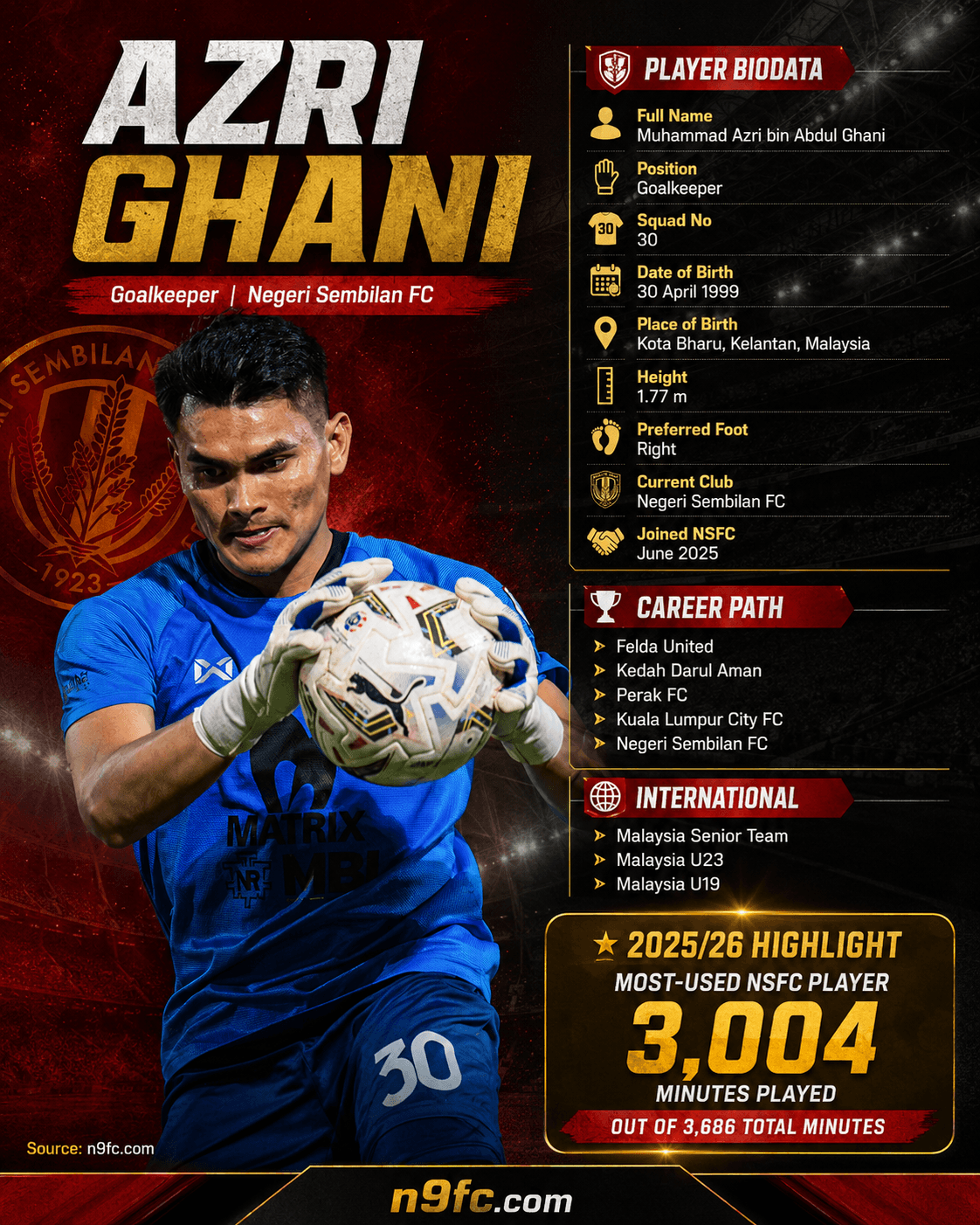
According to Negeri Sembilan FC’s official update, Azri recorded 3,004 minutes of action out of a possible 3,686 minutes throughout the season. That made him the player with the highest playing minutes among The Jangs for the campaign.

On the surface, it is a statistic. But look deeper, and it tells a bigger story about trust, availability, discipline and the importance of having a reliable figure between the posts.

For a team that continues to search for stronger stability and progress, Azri’s season should not be treated as just another number. It should be seen as one of the few clear foundations Negeri Sembilan FC can build on.

More Than Just Game Time

Playing 3,004 minutes in a season is not a small achievement. It means Azri was not only selected regularly, but also stayed fit, prepared and trusted across a long campaign.

In modern football, availability is often underrated. Fans usually focus on technical quality, transfer rumours or match-winning moments. But coaches value something equally important: players who can be counted on week after week.

Azri’s minutes show that he was one of those players.

For a goalkeeper, this matters even more. Unlike outfield positions, goalkeepers are not rotated as freely unless there is injury, a loss of form or a deliberate cup strategy. Once a club identifies its first-choice goalkeeper, the position usually depends heavily on continuity. That continuity helps the defensive line build understanding, communication and confidence.

The fact that Azri played more minutes than anyone else in the squad suggests one thing clearly: Negeri Sembilan FC saw him as their most dependable option in goal.

The No.1 Shirt Comes With Pressure

Being a goalkeeper is one of the most unforgiving roles in football. A striker can miss chances and still score later. A midfielder can lose the ball and recover. A winger can have a quiet match and still produce one decisive cross.

But a goalkeeper’s mistakes are often remembered immediately.

That is why trust is such an important word when discussing Azri’s season. To play more than 3,000 minutes, he had to earn the confidence of the coaching team. He had to convince them that he could handle not only shots and crosses, but also pressure, decision-making and responsibility.

The No.1 shirt is not just about making saves. It is about being mentally ready for moments when the entire match can turn because of one action.

Azri’s record of minutes shows that Negeri Sembilan FC trusted him with that burden repeatedly. That trust should not be overlooked.

Stability Starts From The Back

Every strong team needs a reliable spine. Usually, that spine begins with a goalkeeper, continues through the centre-backs and midfield, and ends with a striker who can carry the attacking responsibility.

For Negeri Sembilan FC, Azri’s consistency gives the team at least one stable point in that structure.

A reliable goalkeeper does not automatically solve every defensive problem, but he gives the team a base. Defenders can play with more confidence when they understand the goalkeeper behind them. Communication becomes clearer. Set-piece organisation becomes more familiar. The rhythm of the defensive unit becomes easier to build.

This is especially important for a team like Negeri Sembilan FC, where the next step must be about building a more complete and competitive squad.

If The Jangs want to improve, they cannot rely only on new signings or short-term emotional boosts. They need consistency in key positions. Azri’s 2025/26 campaign suggests that goalkeeper is one area where the club already has a player capable of carrying serious responsibility.

Beyond The Highlight Saves

When fans discuss goalkeepers, the conversation often starts with saves. That is understandable. A flying save, a strong one-on-one stop or a penalty save can instantly change the mood of a match.

But the best goalkeepers are not defined only by highlight moments.

They are also judged by positioning, communication, concentration, timing and decision-making. They must know when to come off the line, when to stay, when to slow the game down and when to release the ball quickly. They must read danger before it becomes obvious.

A goalkeeper can sometimes have a good match without producing a dramatic save, simply because his organisation and positioning prevented chaos before it happened.

Azri’s high number of minutes suggests that Negeri Sembilan FC valued his broader contribution. He was not merely a player filling a position. He was part of the team’s structure.

That distinction matters.

Availability Is Also A Quality

Football seasons are physically and mentally demanding. Injuries, fatigue, pressure, travelling, form dips and criticism all test a player’s ability to remain ready.

For a goalkeeper, the mental side can be even more intense. Long periods of a match may pass without action, but one lapse in concentration can be costly. Staying focused for 90 minutes, across match after match, requires discipline.

Azri’s 3,004 minutes are therefore not just evidence of selection. They are evidence of professionalism.

To remain available for that amount of game time, a player must manage preparation properly. Training standards, recovery, fitness, focus and attitude all play a part.

This is the kind of quality clubs should value more openly. It may not always trend on social media, but it is essential for building a serious football team.

What It Means For Next Season

Azri’s season gives Negeri Sembilan FC something positive to carry forward. But the club must interpret the statistic correctly.

His consistency is a strength. However, goalkeeper reliability should not be used as an excuse to ignore wider defensive issues. A good goalkeeper can save points, but a better team structure reduces the number of dangerous moments he has to face.

That is the next step for Negeri Sembilan FC.

If Azri remains central to the team’s plans, the club should focus on building a stronger defensive system around him. That means better protection from midfield, clearer organisation at centre-back, more disciplined full-back positioning and improved game management when under pressure.

The goal should not be to make Azri busier. The goal should be to make the whole defensive unit stronger so that his quality becomes part of a complete structure, not a last line of survival.

At the same time, healthy competition is still important. No player should be allowed to become comfortable simply because he played the most minutes. A stronger squad needs competition in every position, including goalkeeper. That does not reduce Azri’s value. In fact, it can push him to become even better.

For Negeri Sembilan FC, the lesson is simple: build around stability, but do not depend on it alone.

A Player Worth Recognising

Azri Ghani’s 3,004 minutes deserve recognition because they represent more than time spent on the pitch. They represent trust earned, responsibility carried and consistency delivered across a demanding campaign.

In a season where Negeri Sembilan FC will have many areas to review, improve and rebuild, Azri’s role should stand out as one of the positives. He gave the team continuity in one of the most important positions on the pitch.

For supporters, it is easy to remember goals, celebrations and big attacking moments. But football progress is also built on players who keep showing up, keep performing and keep carrying responsibility when the team needs stability.

Azri Ghani did that for The Jangs in 2025/26.

And as Negeri Sembilan FC look ahead, his season should be seen not merely as a personal milestone, but as a reminder of what the club needs more of: reliability, professionalism and players who can be trusted when the pressure is real.

The First Step Is Done: Now NSFC Must Turn Licensing Stability Into Football Progress

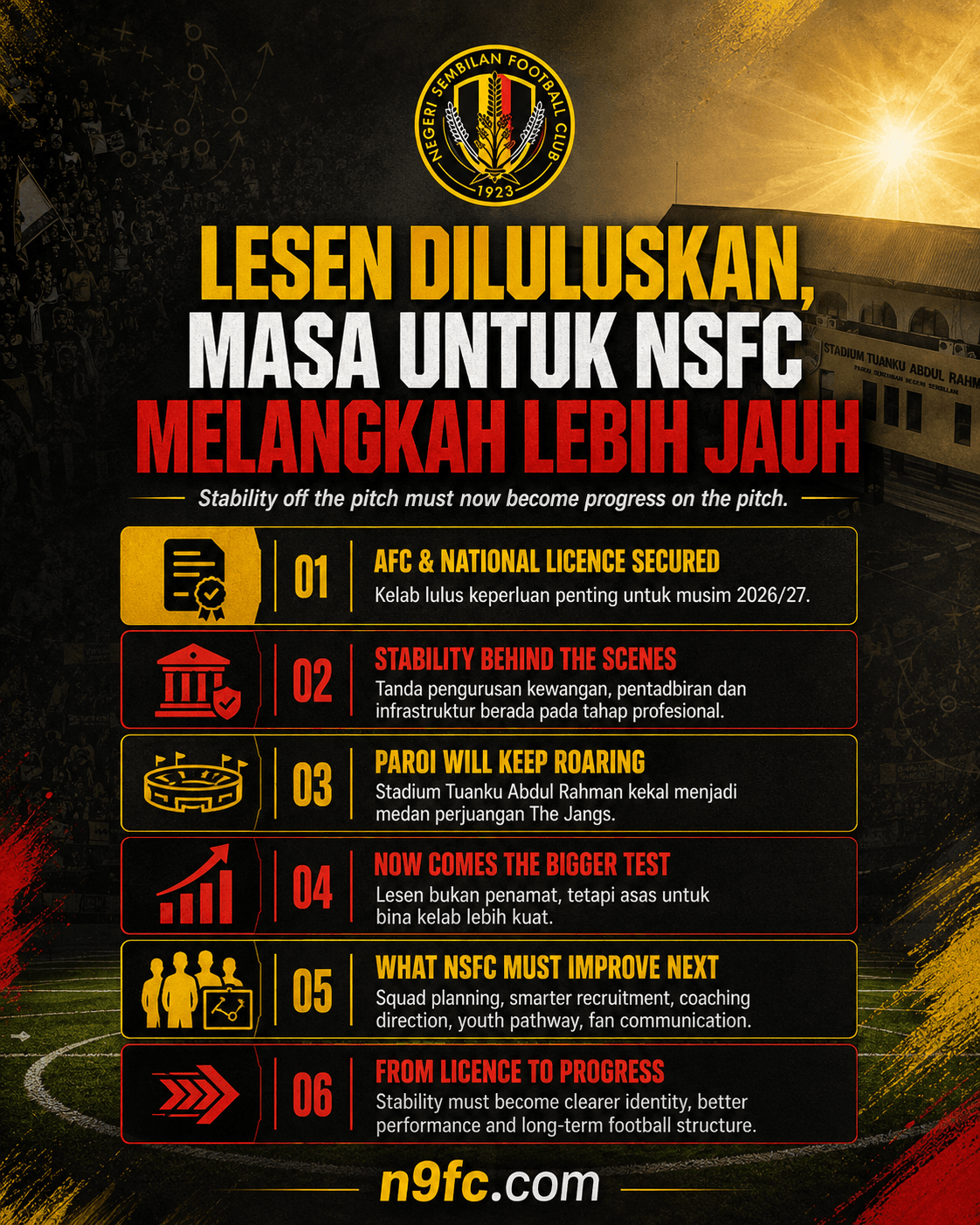
Negeri Sembilan FC have taken an important step towards the 2026/27 season after confirming that the club have successfully obtained both the AFC Licence and National Licence for the upcoming campaign.

On paper, this may sound like an administrative announcement. To some supporters, it may not carry the same excitement as a new signing, a coaching appointment or a big win at Paroi. But in modern football, especially in Malaysian football, licensing approval is not a small matter.

It is a sign that a club has met key professional requirements in areas such as finance, administration, infrastructure and overall governance. It shows that Negeri Sembilan FC have cleared an important test before the new season begins.

That deserves recognition.

But it should also be understood properly. Securing the licence is not the final destination. It is the starting point.

For NSFC, the first step is done. Now comes the harder part: turning off-field stability into real football progress.

Licensing Approval Is More Than Paperwork

Club licensing is often discussed in technical language, but the meaning is simple. A football club must prove that it is professionally managed enough to compete at the required level.

It is not just about having a team, a stadium and a set of jerseys. A club must show that it has a functioning structure behind the scenes. That includes financial management, administrative organisation, infrastructure readiness and compliance with football authority standards.

For Negeri Sembilan FC, receiving both the AFC Licence and National Licence sends a positive message. It shows that the club have managed to meet the standards required for the upcoming season.

In a football environment where clubs can face financial uncertainty, unpaid commitments, administrative weaknesses or licensing problems, this kind of approval matters. It tells supporters that the club are not heading into the new campaign blindly. There is at least a formal base of stability in place.

That is important because football problems rarely begin only on the pitch. Very often, what fans see during matchday is the result of decisions made months earlier in offices, boardrooms and training grounds.

A poorly run club will usually struggle sooner or later. A more organised club gives itself a better chance to build properly.

Why This Matters To The Supporters

For the supporters, this announcement carries emotional weight too.

The club’s statement ended with a powerful line: “Paroi akan terus bergema untuk musim 2026/2027.” For Negeri Sembilan fans, that is not just a sentence. It is a reminder that football in Paroi continues. It is a reminder that The Jangs will still have a team to stand behind, a stadium to fill and a new season to hope for.

Supporters do not only follow a club because of results. They follow it because it represents place, identity and memory. Negeri Sembilan FC are not just another team in the league. For many fans, the club represent Seremban, Paroi, family memories, weekend routines and local pride.

So when the club confirms that it has secured the necessary licences for the new season, it brings reassurance. It tells fans that, despite all the ups and downs, NSFC remain in the fight.

The club also gave credit to sponsors and loyal supporters. That is fair. In Malaysian football, sponsorship and fan loyalty are not side issues. They are part of survival. Without commercial backing, clubs struggle. Without supporters, the club loses its soul.

The Jangs have had to stay patient through many phases of the club’s journey. That loyalty should never be taken lightly.

Stability Must Now Become A Football Plan

Still, this is where the conversation must move beyond celebration.

Licensing approval proves that NSFC have met the required standards. But it does not automatically prove that the team will be competitive. It does not automatically solve recruitment issues. It does not automatically create a playing identity. It does not guarantee better results.

That is the difference between being ready to participate and being ready to progress.

For Negeri Sembilan FC, the real question now is clear: what will the club do with this stability?

A licensed club must now become a better football club.

That means planning cannot stop at administration. The football department must also show direction. The squad must be built with purpose. Recruitment must be smarter. The coaching direction must be clear. Youth development must become more than a nice phrase. Supporters must be able to see what kind of club NSFC are trying to become.

This is where the next phase matters.

Passing the licensing test keeps the club in the game. Building the right football structure is what moves the club forward.

The Big Football Questions Ahead

The 2026/27 season should not be approached as just another reset. Negeri Sembilan need more than yearly survival. They need a clearer sporting direction.

The first question is about identity.

What kind of football do NSFC want to play? Are they building a team that presses aggressively? A team that controls possession? A team that focuses on compact defending and quick transitions? A team built around young local players? Or a squad that depends heavily on foreign experience?

There is no single correct answer. But there must be an answer.

Too many clubs change direction every season. A new coach arrives, the system changes, players are signed for one idea, then another coach comes in and wants something completely different. That kind of cycle wastes money, time and talent.

NSFC should avoid that trap.

The club need to ensure that coaching appointments, player recruitment and youth development all point in the same direction. If the club wants to become more stable on the pitch, it must stop treating every season as a completely separate project.

The second question is recruitment.

Negeri Sembilan do not need random signings. They need the right signings. That means players who fit the coach’s plan, the club’s budget and the physical demands of the league.

Smart recruitment is not always about big names. Sometimes it is about finding reliable players who understand their roles. Sometimes it is about signing players who improve the dressing room. Sometimes it is about avoiding expensive mistakes.

Supporters will always be excited by new arrivals, but the club must judge recruitment by suitability, not noise.

The third question is youth development.

Negeri Sembilan have always had football talent. The issue is whether that talent has a real pathway. A club cannot speak about long-term growth while giving young players no route into the senior structure.

Youth football, development teams and local talent identification must be connected to the first team. Otherwise, the pathway becomes decorative rather than functional.

A club like NSFC should not only buy solutions. It should also build them.

Communication And Trust Matter

Another important area is communication.

Supporters do not expect perfection. Most fans understand that Malaysian football comes with financial limits, competitive pressure and difficult decisions. But what supporters want is clarity.

They want to know that the club has a plan. They want to see consistency. They want signs that lessons are being learned. They want ambition, but they also want honesty.

This is where NSFC can improve the relationship between the club and its fanbase. Announcements such as the licensing approval are positive. But communication should not only happen when there is good news. Fans appreciate transparency when things are difficult too.

Trust is built through consistency. Not through one post, one statement or one campaign.

If the club wants supporters to believe in the project, the project must be visible.

Credit Where It Is Due

It is important to be fair. Securing the AFC and National Licences is a real achievement, and the club management deserve credit for completing that process.

The statement also mentioned the role of NSFC chairman YAB Dato’ Seri Utama Haji Aminuddin Harun, as well as the support of sponsors and loyal fans. That recognition is appropriate.

In Malaysian football, stability is not guaranteed. Some clubs have learned the hard way that weak administration can damage everything else. When the structure behind the scenes is not strong enough, the team eventually suffers.

So yes, NSFC should be congratulated for getting this step done.

But the club should also see this as a responsibility. A licence gives the club the right to compete. It also gives the club the responsibility to improve.

The Opportunity For 2026/27

The 2026/27 season is now an opportunity for Negeri Sembilan FC to reset with more purpose.

Not merely to exist. Not merely to survive. Not merely to tell supporters that the club are still here.

The next step is to become more competitive, more organised and more convincing.

That does not mean fans should demand instant success or unrealistic trophies. But they can demand progress. They can demand better planning. They can demand a clearer football identity. They can demand that the club make decisions that look connected, not reactive.

This is the moment for NSFC to move from administrative readiness to football readiness.

The licence approval has given the club a platform. Now the platform must be used properly.

Licence Secured, Now Build The Future

For Negeri Sembilan FC, the message is simple.

The first step is done. The club have secured both the AFC Licence and National Licence. Paroi will continue to roar in the 2026/27 season. Supporters have reason to feel relieved and encouraged.

But football does not move forward through licences alone.

The real judgement will come from what happens next: the coaching direction, squad planning, recruitment decisions, youth pathway, communication with supporters and performances on the pitch.

NSFC have cleared the administrative hurdle. That is good news.

Now they must turn that stability into something bigger.

A stronger team. A clearer identity. A better structure. A club that supporters can believe in not only because of history, but because of direction.

The licence has secured NSFC’s place for the new season.

Now the club must secure something even more important: a clear football future.

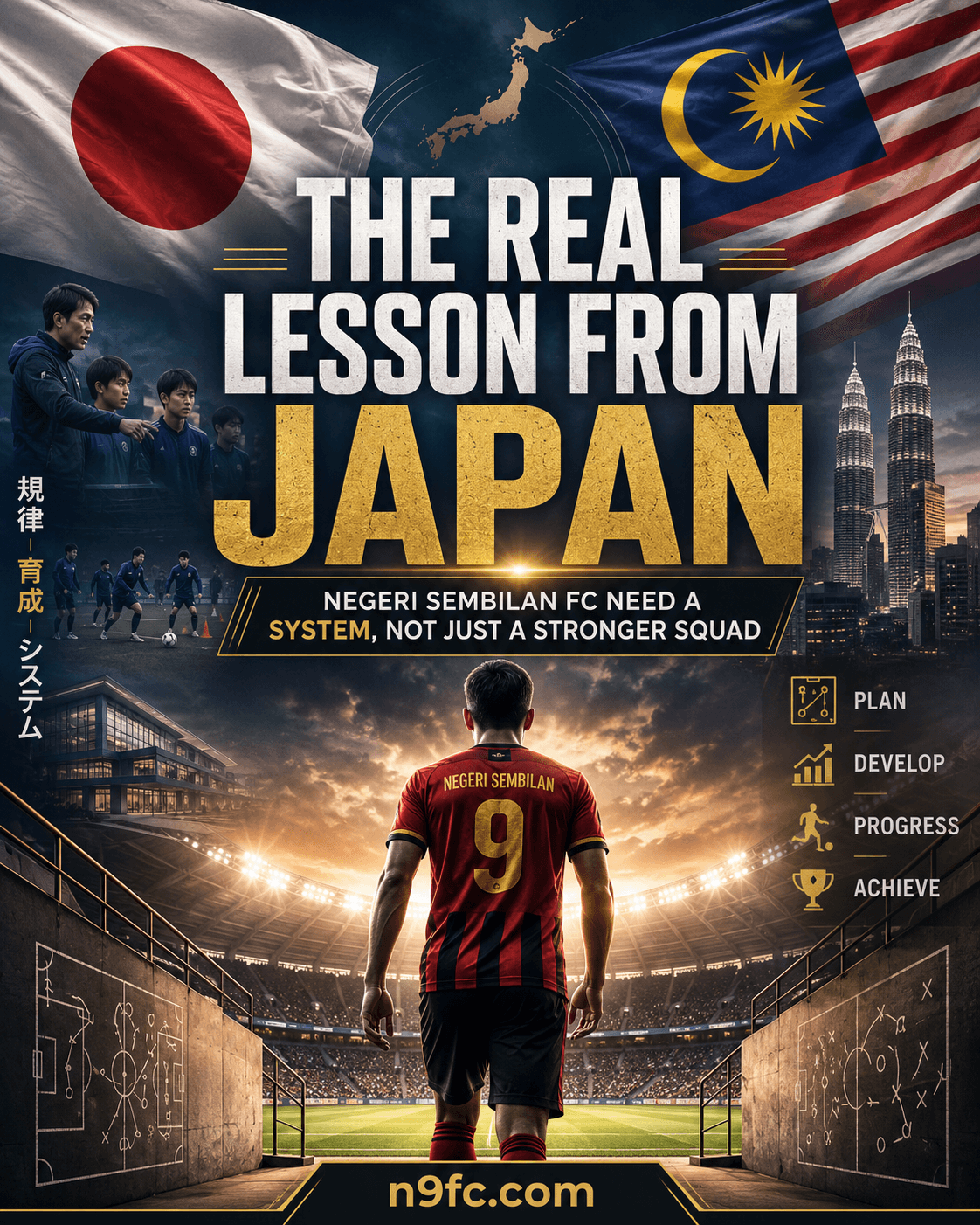
The Real Lesson From Japan: Negeri Sembilan FC Need A System, Not Just A Stronger Squad

Negeri Sembilan FC’s next step forward will not be decided by one signing, one coach, one foreign player, or one good transfer window.

Those things matter, of course. A better squad can improve results. A stronger coach can bring better organisation. A few smart signings can change the mood around the club. But if Negeri Sembilan FC truly want to move beyond short-term survival and become a more stable, competitive football club, the bigger question is this:

Does NSFC have a proper football system?

That is the real lesson worth taking from Japan.

Recently, Faliq Firdaus shared his experience after attending a course with the J-League, Japan FA, and representatives from several major Japanese clubs including Gamba Osaka, Urawa Red Diamonds, Vissel Kobe, Yokohama F. Marinos and others at the J-League office in Tokyo.

His reflection was simple but important. Japan’s football success is not built overnight. It is built through patience, planning, shared direction and proper structure.

For Negeri Sembilan FC, that message should not be treated as just another motivational takeaway. It should be treated as a serious football lesson.

Because the gap between a club that only signs players and a club that builds a system is massive.

Japan’s Football Growth Was Not An Accident

The J-League started in 1993 with only 10 teams. Today, according to Faliq’s sharing, the wider J-League structure has grown to around 60 teams.

That growth did not happen by luck.

Japan did not become one of Asia’s strongest football nations simply because they had talented players. Talent was only one part of the story. The bigger difference was the ecosystem built around that talent.

They developed clubs. They improved competitions. They created clearer youth pathways. They invested in coaching. They studied data. They linked football ambition with commercial planning. They gave clubs a structure to grow.

That is why Japan’s football model is often respected across Asia. It is not perfect, but it is organised. More importantly, it understands that football progress needs time.

This is a lesson Malaysian football often struggles to accept.

Too many clubs want quick success. New coach, new imports, new slogan, new target. Then when results do not come fast enough, the cycle starts again. Another reset. Another rebuild. Another season of “we need time”.

Japan’s lesson is different. Progress requires a long-term plan that survives beyond one season.

The Most Important Word: Alignment

One of the strongest points from Faliq’s post was this: everyone must be aligned.

In Malay, the phrase “sehati dan senada” captures it perfectly.

A football club cannot grow properly if every department moves in a different direction. The management may want one thing, the head coach may want another, the academy may operate separately, the commercial team may have no connection to football objectives, and fans may be left guessing what the club is actually trying to build.

That kind of environment creates confusion.

For Negeri Sembilan FC, alignment should mean several things.

The club leadership must know what kind of football direction they want. The coaching staff must fit that direction. Recruitment must support that football idea. Youth development must prepare players for the senior team, not exist only as a separate programme. Commercial planning must strengthen the football operation. Communication with supporters must be clear enough for fans to understand the process.

Without alignment, every season becomes reactive.

If the team struggles, the first answer becomes “change the coach”. If the attack is weak, the answer becomes “sign a striker”. If young players do not break through, the answer becomes “they are not ready”. Some of those answers may be partly true, but they do not solve the bigger issue.

The bigger issue is whether the club is functioning as a joined-up football organisation.

A Stronger Squad Helps. A Stronger System Lasts.

Negeri Sembilan FC fans naturally want better players. That is normal. Football is emotional. Supporters want to see quality imports, reliable local players, strong defenders, creative midfielders and clinical finishers.

But a stronger squad alone is not enough.

A good squad can improve one season. A good system can improve five seasons.

This is where NSFC must be honest with itself. If recruitment is not connected to a clear playing style, the club will keep signing players based on short-term needs. If coaching changes disrupt the whole football direction, the team will keep starting again. If youth development is not connected to the first team, young players will continue to struggle for a real pathway.

A football system gives the club continuity.

It helps the club answer important questions:

  • What style of football should Negeri Sembilan FC play?
  • What type of players fit that style?
  • What kind of coach fits the club’s direction?
  • Which academy players are being prepared for senior football?
  • What positions should the club develop internally?
  • What areas require outside recruitment?
  • How does the club measure progress beyond league position?

Without these answers, a club can spend money and still stand still.

That is why the real issue is not only whether NSFC can build a stronger squad. The real issue is whether NSFC can build a stronger football structure behind that squad.

The Honest Benchmark: Where Does NSFC Really Stand?

Faliq’s reflection included a very honest point: in terms of size and operation, Negeri Sembilan FC may be closer to a J3 or JFL-level club in Japan’s football structure.

Some fans may not like hearing that. But it should not be taken as an insult.

In fact, it may be one of the most useful observations.

A club cannot improve if it does not understand its real level. Overestimating your structure is dangerous. It leads to unrealistic expectations, poor planning and emotional decision-making.

If NSFC’s current operation is closer to a lower-division Japanese club, then the club should study what those clubs do well. How do they control costs? How do they develop players? How do they grow commercial revenue? How do they use their community? How do they build a clear football identity despite limited resources?

There is no shame in starting from a realistic benchmark.

The danger is pretending to be bigger structurally than the club actually is.

Negeri Sembilan FC have history, identity and passionate supporters. But modern football is not powered by history alone. It requires competent administration, sustainable finances, smart football planning, strong local talent development and proper performance management.

The club has potential. But potential only matters if it is organised.

What A Proper NSFC System Should Look Like

If Negeri Sembilan FC want to learn seriously from Japan, the club does not need to copy the J-League blindly. That would be unrealistic.

Malaysia has different economics, different football culture, different governance problems and different competition structures.

But NSFC can still adapt the principles.

A proper club system should include several core pillars.

1. A Clear Playing Identity

Negeri Sembilan FC need to know what kind of football they want to play.

This does not mean every coach must use the exact same formation forever. Football must remain flexible. But the club should have a broad identity.

Does NSFC want to be a high-pressing team? A compact counter-attacking team? A possession-based team? A physically aggressive team? A development-focused team that gives minutes to younger players?

Once the identity is clearer, recruitment becomes smarter.

The club stops signing random players and starts signing players who fit specific roles. The academy can also prepare young players based on the same football principles.

Without identity, recruitment becomes guesswork.

2. Smarter Recruitment

A serious club does not sign players only because they are available, popular, familiar or recommended by agents.

Recruitment should be based on role, data, character, injury record, tactical fit and squad balance.

For NSFC, this is especially important because the club cannot afford too many mistakes. Bigger clubs may survive poor signings because they have deeper budgets. Smaller clubs suffer badly when recruitment goes wrong.

A smart recruitment structure should ask:

  • Does this player fit the coach’s tactical plan?
  • Does he solve a real squad problem?
  • Is his injury record acceptable?
  • Does his salary make sense?
  • Is he blocking a young player who could be developed?
  • Can he improve the team immediately?
  • Can he still contribute beyond one season?

Recruitment is not just about finding good players. It is about finding the right players for the club’s direction.

3. A Real Youth Pathway

Youth development is not just about having youth teams.

The real question is whether there is a pathway.

A pathway means the club can clearly identify how a player moves from school football or grassroots level into youth teams, then into development squads, then toward the senior team.

Faliq mentioned that Japanese development teams at U18, U15 and U12 levels often compete regionally according to their areas, helping to control development costs.

This is highly relevant to Negeri Sembilan.

NSFC should not only think about youth development as a branding exercise. It should become a serious football pipeline. The club should strengthen relationships with schools, local academies, district football structures and youth competitions.

A state like Negeri Sembilan should be able to create a clearer local talent ecosystem.

The aim should not be to produce one star by luck. The aim should be to create a repeatable pathway that produces players consistently.

4. Better Development Competition

One of the problems in football development is the gap between youth football and senior football.

Many young players look promising at youth level but struggle to break into senior teams because the jump is too big. They need competitive minutes, physical exposure, tactical learning and pressure situations.

That is why development leagues, reserve teams, B-teams or structured youth competitions are important.

Faliq mentioned that the J-League is looking at a B21 league involving 10 teams. Whether Malaysia should copy that exact model is another debate. But the principle is important.

Young players need proper matches.

Training alone is not enough. Friendly games are not enough. Sitting on the bench is not enough.

For NSFC, this raises a serious question: how can the club create more meaningful competitive minutes for its young players?

If there is no bridge between youth and senior football, many talents will continue to disappear before they mature.

5. Coach Development

Players are not the only ones who need development. Coaches do too.

If NSFC want a long-term system, the club must also invest in coaching knowledge. This includes senior coaches, assistant coaches, youth coaches, goalkeeper coaches, fitness coaches and analysts.

A club’s football culture is shaped by its coaches.

If coaches are not aligned, the development pathway breaks. If youth coaches teach one style and the senior team plays another, players struggle to adapt. If assistant coaches are not empowered, knowledge does not grow internally.

Japan’s model shows the value of learning and sharing. Faliq’s post itself is proof that exposure matters.

But exposure must lead to implementation.

The question is not only who attends courses. The question is what changes after they return.

6. Data And Performance Analysis

Football is still a human game. Data cannot replace judgement.

But modern clubs cannot ignore data.

Faliq highlighted that Japanese research over 13 years showed strong correlations involving team spending, success, office staff expenditure and club sales.

That point matters because it shows football performance is not isolated from the rest of the organisation.

For NSFC, data should not only mean match statistics. The club should be tracking player minutes, injuries, physical output, recruitment efficiency, youth progression, attendance, fan engagement, sponsorship performance and commercial growth.

A serious club uses data to ask better questions.

Why are certain players injured often? Which positions are consistently weak? Which youth players are improving fastest? Which signings give the best value? Which fan engagement activities increase attendance or merchandise sales?

Data does not guarantee success. But without data, too many decisions depend on instinct alone.

7. Commercial And Administrative Strength

This is the part many fans overlook.

A football club is not only 11 players on the pitch. It is also an organisation.

Office staff, sponsorship teams, media teams, ticketing operations, merchandising, community engagement, finance, matchday operations and digital content all affect the club’s growth.

A club with weak administration will eventually struggle on the pitch.

Why? Because football needs money, planning and execution.

If commercial growth is weak, the football budget suffers. If media output is poor, the club loses attention. If ticketing and matchday experience are weak, fan connection drops. If sponsorship management is poor, revenue opportunities disappear.

For NSFC, this is a major area of potential.

The club has a clear identity, a loyal fanbase and a state football culture. But these assets must be organised properly. Passion alone does not generate sustainable revenue. It must be converted into membership, tickets, merchandise, sponsorship, digital reach and community connection.

The Next Season Must Be More Than Another Rebuild

Looking ahead, Negeri Sembilan FC’s next phase should not only be about assembling a stronger squad for one campaign.

The club must think deeper.

The head coach decision should fit the long-term football direction. Contract renewals should reflect squad planning, not just emotion. Foreign player recruitment should be based on role and tactical fit. Local signings should improve depth and balance. Youth players should be given a realistic development route.

Most importantly, the club must communicate its direction more clearly.

Fans do not need every internal detail. But supporters deserve to understand what kind of club NSFC are trying to become.

Are we building around youth? Are we targeting gradual league improvement? Are we creating a specific playing identity? Are we strengthening the academy? Are we improving commercial operations? Are we trying to become a more self-sustaining club?

Clear direction creates patience.

When fans see a real plan, they are more likely to support the process. But when everything looks reactive, frustration grows quickly.

The Risk: Learning From Japan But Doing Nothing

There is one uncomfortable truth.

Malaysian football has never lacked ideas. There have been many courses, visits, seminars, development plans and foreign models studied over the years.

The problem is implementation.

It is easy to admire Japan. It is easy to say “we should learn from them”. It is easy to come back inspired.

The harder part is changing how the club actually works.

If NSFC truly want to take lessons from Japan, the club must turn learning into action. Not vague action. Real action.

Set a football direction. Build a recruitment framework. Strengthen youth links. Improve coaching alignment. Track performance data. Grow commercial operations. Communicate the plan.

That is how a club moves from inspiration to progress.

Otherwise, the Japan lesson becomes just another nice story.

Build The Club, Not Just The Team

Negeri Sembilan FC do not need to become a J-League club overnight. That would be unrealistic.

But NSFC can learn the deeper lesson.

Football progress is not built only by chasing better players every season. It is built by creating a system where every part of the club supports the same objective.

Management, coaching, recruitment, youth development, data, commercial planning, administration and fan engagement must move together.

That is what separates a club with short-term ambition from a club with a real future.

For Negeri Sembilan FC, the challenge is clear. The club can continue treating every season as another rebuild, or it can start building something more permanent.

A stronger squad may win matches.

But a stronger system can build Negeri Sembilan FC for the next decade.

Thank You, Jang: An Sang Su Closes His Negeri Sembilan FC Chapter After Two Seasons

Negeri Sembilan FC appear set to say goodbye to Korean midfielder An Sang Su, after the player posted an emotional message on Instagram suggesting that his time with the club has come to an end.

Sharing a black-and-white team photo, An wrote a short but meaningful caption:

“End of the Chapter 2024–2026”

It was not a long farewell statement. It did not need to be. For Negeri Sembilan supporters, the message was clear enough. After two seasons with the Jang, An Sang Su seems ready to close his chapter in Seremban and move into the next stage of his football journey.

A Simple Message With Strong Meaning

Football goodbyes are not always announced through official statements. Sometimes, they arrive quietly through a few words on social media.

An Sang Su’s post carried that kind of feeling. The phrase “End of the Chapter” suggests reflection, closure and gratitude. When paired with the timeline 2024–2026, it points strongly towards the end of his spell with Negeri Sembilan FC.

The reaction from fans made the moment more emotional. Several supporters left farewell messages, thanking him for his service and wishing him well in his next journey.

One fan wrote:

“Once a Jang always a Jang. Terima kasih untuk khidmat anda di NSFC. Good luck on your journey.”

Another added:

“Good luck for your new chapter.”

There were also warm comments from teammates and fellow Korean-speaking players, showing that An’s influence was not limited to what happened on the pitch. He clearly built respect within the group as well.

A Midfielder Who Served The Team With Commitment

An Sang Su’s role at Negeri Sembilan FC was in midfield, an area of the pitch that often demands discipline, intelligence and selfless work.

Midfielders do not always get the biggest headlines. Goalscorers are remembered for finishes. Goalkeepers are remembered for saves. But midfielders are often judged by the small details — positioning, pressure, passing decisions, defensive support and how well they help the team connect one phase of play to another.

During his time with Negeri Sembilan, An was part of a squad that went through changes, challenges and rebuilding phases. In that kind of environment, consistency and professionalism matter.

He may not always have been the loudest figure in the team, but his contribution formed part of Negeri Sembilan’s journey across two seasons.

Part Of The Jang Family

What makes this farewell meaningful is the tone of the supporters’ response.

Fans do not simply thank a player because he wore the shirt. They usually remember attitude. They remember whether a player respected the badge, worked hard and carried himself professionally.

The phrase “Once a Jang, always a Jang” captures that sentiment perfectly.

For Negeri Sembilan supporters, An Sang Su was not just an import player passing through. He became part of the dressing room, part of matchday memories and part of the club’s recent story.

In football, not every chapter ends with a trophy or a grand moment. Some chapters are defined by commitment, effort and the respect a player earns along the way.

What His Exit Means For Negeri Sembilan FC

If An Sang Su’s departure is confirmed officially, Negeri Sembilan FC will need to look carefully at how they rebuild their midfield for the next campaign.

Midfield is one of the most important areas for any team that wants to improve. It controls tempo, protects the defence, supports the attack and gives structure to the entire system.

Replacing a foreign midfielder should not be treated as a simple name-for-name change. Negeri Sembilan must consider what profile the squad really needs next.

The club may need a midfielder who can offer:

  • strong ball progression,
  • better control under pressure,
  • defensive discipline,
  • leadership in central areas,
  • physical intensity for Malaysian football,
  • and the ability to fit the tactical direction of the next head coach.

That decision will be important. Negeri Sembilan cannot afford to simply fill an import slot. The next midfield signing must make the team stronger, more stable and more competitive.

A Farewell With Respect

An Sang Su’s Instagram post may be short, but it carries the feeling of a player who understands that one part of his career has reached its ending.

From 2024 to 2026, he wore the Negeri Sembilan colours and became part of the Jang family. He experienced the demands of Malaysian football, the pressure of representing a historic club and the support of fans who value effort and loyalty.

If this is truly goodbye, the message from the Negeri Sembilan faithful is simple:

Thank you, An Sang Su. Good luck in your next chapter. Once a Jang, always a Jang.

Step By Step Forward: Negeri Sembilan FC’s 2025/26 Season Shows Progress, Promise And The Need For A Bigger Next Step

Negeri Sembilan FC’s 2025/26 campaign was not a perfect season. It was not a trophy-winning season either. But it was a season that deserves a fair and balanced assessment.

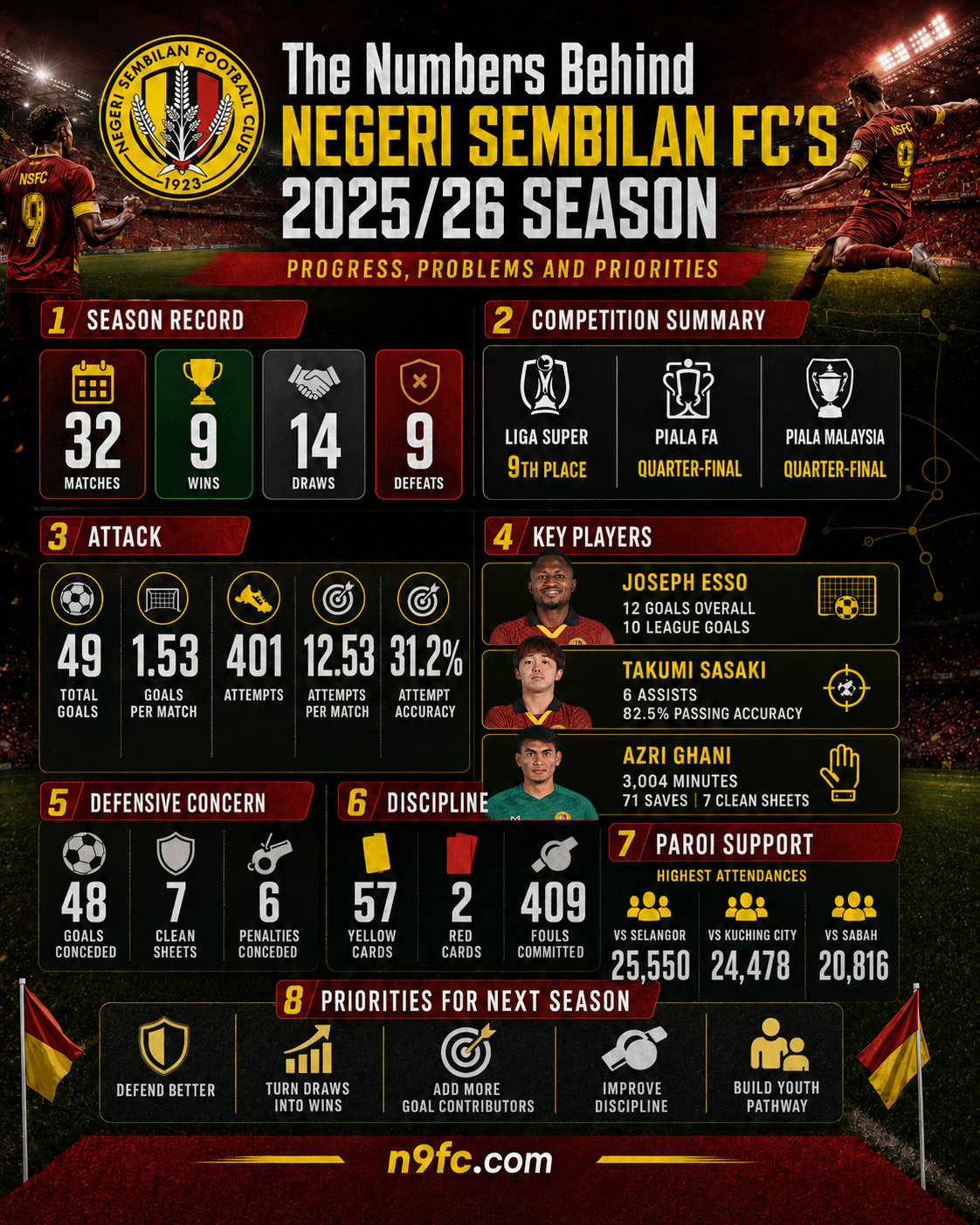
After finishing 12th in the previous Super League campaign, Negeri Sembilan climbed to 7th this season. That five-place improvement matters. It shows that the team moved away from the lower end of the table and started to look more competitive again.

The club also reached the quarter-finals of both the FA Cup and Malaysia Cup, scored 49 goals across all competitions, and recorded a total attendance of 152,928 supporters. The highest crowd came against Selangor FC, with 25,550 fans turning up, the club’s best attendance since 2017.

Those numbers tell a clear story: Negeri Sembilan FC took a step forward.

But the real question now is whether that step becomes the start of a bigger climb — or just another temporary improvement.

From 12th To 7th: A Clear Sign Of Progress

The most obvious positive from Negeri Sembilan’s 2025/26 season is the league position.

Finishing 7th in the Super League may not sound spectacular at first glance. For a club with Negeri Sembilan’s history and fan base, mid-table should never be treated as the final ambition. But context matters.

This was a team that finished 12th in the previous season. Moving up five places is not a small achievement. It suggests better structure, stronger performances, and a squad that was more capable of competing across the season.

For supporters, the improvement also brings relief. After a difficult period where NSFC had to worry more about survival than ambition, the 2025/26 campaign offered something more positive. The team looked like it was building again.

However, this is where the club must be careful.

A 7th-place finish should be seen as a platform, not a destination. If the club over-celebrates it, the danger is complacency. The real value of this season is not simply where NSFC finished, but what the club chooses to do next.

The next target should be clear: become a stable top-half team and push seriously towards the top six.

Cup Runs Added More Weight To The Season

Negeri Sembilan also had respectable runs in both domestic cup competitions.

The club reached the quarter-finals of the FA Cup and Malaysia Cup, showing that the team was capable of staying competitive beyond the league campaign. In knockout football, consistency, discipline and mentality are tested differently. NSFC did enough to show that they could handle those moments better than before.

The campaign included aggregate wins such as the 5-1 result against PDRM FC and the 1-0 result against Imigresen FC. These may not be the biggest wins in Malaysian football, but they were important results in the context of NSFC’s season. They helped build momentum and gave supporters more meaningful matches to follow.

Still, quarter-finals should not become the ceiling.

For a club trying to rebuild credibility and ambition, the next step is to turn these cup runs into semi-final appearances. Cup competitions can also be an important route for NSFC to rebuild excitement, attract supporters, and give the squad experience in high-pressure matches.

Respectable is good. But ambitious clubs cannot stay satisfied with respectable forever.

49 Goals Scored: Encouraging Attacking Signs

One of the stronger positives from the season was Negeri Sembilan’s attacking output.

The team scored 49 goals across all competitions. That is a healthy number and suggests NSFC had enough attacking quality to hurt opponents. It also shows that the team was not simply surviving games or playing purely defensive football.

For fans, goals matter. They bring energy to the stadium, create belief, and make the team easier to support. A side that can score regularly gives itself a chance in most matches.

This attacking return should be treated as a foundation for next season. The club must identify which combinations worked, which players contributed consistently, and where the attack can still improve.

But there is another side to the story.

The season wrap-up also showed that NSFC conceded 47 goals. That means the difference between goals scored and goals conceded was very narrow. In simple terms, Negeri Sembilan had attacking growth, but not enough defensive control.

That is probably the biggest football lesson from the season.

Defensive Stability Must Be The Main Priority

If Negeri Sembilan want to move from 7th place to the top six, the defensive record must improve.

Conceding 47 goals across all competitions suggests the team was too open at times. It does not mean every defensive problem came from the backline alone. Modern football does not work that way. Goals conceded are usually connected to the whole team structure: pressing, midfield protection, full-back positioning, set-piece organisation, goalkeeper decisions, and game management.

This is where the club needs a serious review.

Did NSFC concede too many soft goals? Did the midfield give enough protection? Were there enough leaders in the defensive unit? Did the team lose concentration after scoring? Did tactical changes during matches expose the backline?

These are not small questions. They are the kind of questions that decide whether a team stays in mid-table or climbs higher.

The positive is that NSFC already showed they can score. If the club can reduce goals conceded while keeping the attacking output strong, the jump from 7th to top six becomes much more realistic.

The next head coach, whether confirmed internally or appointed from outside, must make defensive organisation a major priority.

Fan Support Remains One Of NSFC’s Biggest Strengths

Beyond results, one of the most encouraging numbers from the season was the attendance.

Negeri Sembilan recorded a total attendance of 152,928 supporters across all competitions. That is a major positive. It shows that the fan base is still alive, still emotionally connected, and still willing to turn up when there is belief around the team.

The peak attendance of 25,550 against Selangor FC was especially important. According to the club’s season wrap-up, it was the highest attendance since 2017.

That number should not be ignored.

It proves that Paroi can still attract a big crowd. It proves that Negeri Sembilan football still has strong local pull. It also proves that the club has commercial potential if the football project is managed properly.

But again, the challenge is consistency.

One big attendance is a statement. Regular strong attendance is a foundation. NSFC must now ask how they can convert big-match interest into regular matchday loyalty.

That means improving more than just the team. It means better matchday experience, stronger fan engagement, smarter ticket promotion, better merchandise strategy, and clearer communication from the club.

Supporters are not just spectators. They are part of the club’s value.

The Selangor Match Showed What Is Possible

The 25,550 attendance against Selangor FC should be studied carefully by the club.

Why did that match attract such a strong crowd? Was it because of the opponent? Was it because of timing? Was the team in good form? Was the promotion stronger? Were fans more emotionally invested in that fixture?

Whatever the answer, the club should not treat it as a one-off success and move on.

Big clubs learn from their best days. They study what worked, repeat what can be repeated, and improve what can be improved.

For NSFC, that Selangor match was more than just an attendance figure. It was proof of potential. The Negeri Sembilan football public is still there. The challenge is giving them enough reasons to return more often.

If the team performs with energy, the club communicates clearly, and the matchday product improves, Paroi can become a stronger home ground again.

That matters because football is not only about tactics and transfers. Atmosphere changes games. A strong home crowd can give players confidence and make opponents uncomfortable.

NSFC should aim to make Paroi feel like a proper advantage again.

A Season That Moved The Club Out Of Survival Mode

The biggest value of the 2025/26 season may be psychological.

Negeri Sembilan did not look like a club trapped only in survival mode. The season gave the impression of a team trying to rebuild some identity and competitiveness.

The league improvement, cup quarter-finals, goals scored, and fan attendance all point in the same direction: the club has a base to work with.

That matters because rebuilding in football is not instant. A club does not move from instability to serious contention overnight. Progress usually happens in layers.

First, a team must stop the decline. Then it must become competitive. Then it must become consistent. Only after that can it start challenging the stronger sides regularly.

For NSFC, 2025/26 felt like the second stage of that process. The decline was slowed, and competitiveness improved. Now the club must move into the next phase: consistency.

The Next Step Must Be Bigger

This is the most important part.

Negeri Sembilan cannot afford to stand still.

A five-place improvement is good, but other clubs will also strengthen. If NSFC only maintain the same level, they may not move forward. In football, standing still often means falling behind.

The club must now be sharper in several areas.

Recruitment needs to be more precise. Imports must add real value, not just fill foreign player slots. Local depth must improve because a long season cannot rely only on a small group of key players. The defence needs strengthening. The midfield needs balance. The attack needs consistency beyond individual moments.

The head coach decision will also be crucial. NSFC need clear tactical direction. It is not enough to appoint a coach based on reputation alone. The coach must fit the club’s squad, budget, league reality, and long-term plan.

The next coach must answer practical questions:

Can he improve the defensive structure?

Can he develop local players?

Can he manage imports effectively?

Can he make Paroi a difficult place for opponents?

Can he build a team that is not just competitive in selected matches, but reliable across the season?

That is what separates a promising season from a proper project.

Top Six Should Be The Natural Target

After finishing 7th, the logical next target is the top six.

This does not mean NSFC should make unrealistic promises. The Malaysian Super League is competitive, and several clubs have stronger budgets. But ambition must be clear.

A top-six push is realistic enough to be taken seriously, but demanding enough to force improvement.

To get there, NSFC will likely need:

  • Better defensive organisation
  • Stronger squad depth
  • More consistent home form
  • Smarter recruitment
  • Better game management
  • Fewer avoidable goals conceded
  • Continued fan support
  • Clear tactical identity from the coaching team

The club has shown it can move forward. Now it must prove that it can move forward again.

Supporters Deserve A Clearer Project

For fans, the 2025/26 season gave reasons to believe. But belief becomes stronger when supporters understand the direction of the club.

NSFC do not need to promise trophies immediately. That would be unnecessary and unrealistic. But the club should show that it has a clear football plan.

Supporters want to know what kind of team NSFC are trying to become. Are they building around young local players? Are they focusing on experienced stability? Are they aiming for a more aggressive attacking style? Are they trying to become harder to beat first?

A football club does not need to reveal every internal detail, but it does need to communicate direction.

When fans see progress and understand the plan, patience becomes easier. When they see confusion, even decent results can feel fragile.

That is why the next few months are important. Contract decisions, coaching structure, recruitment, and pre-season planning will tell supporters whether NSFC are serious about building on this season.

Balanced Verdict: Progress, Promise And Pressure

Negeri Sembilan FC’s 2025/26 season should be viewed positively, but not blindly.

The positives are clear. A 7th-place finish after coming from 12th is genuine progress. Quarter-final appearances in both the FA Cup and Malaysia Cup added weight to the campaign. The team scored 49 goals, showing attacking improvement. The total attendance of 152,928 proved that fan support remains strong. The 25,550 crowd against Selangor FC showed that Paroi still has big-match power.

But the concerns are also clear. Conceding 47 goals is too high for a team that wants to climb further. The club still needs greater consistency. The next coaching decision must be right. Recruitment must be sharper. Defensive structure must improve.

This was a step forward. No doubt.

But the next step must be bigger.

For Negeri Sembilan FC, the 2025/26 season should not be remembered as the end of a rebuild. It should be remembered as the season that gave the club a better base to build from.

Now comes the harder part: turning progress into real momentum.

Hobin Jang Hobin.

Mio Tsuneyasu Drops Next Season Hint After Reflecting On Limited Minutes With Negeri Sembilan FC

Mio Tsuneyasu has given Negeri Sembilan FC supporters something to think about after posting an honest end-of-season reflection that appears to point toward unfinished business ahead of the next campaign.

The Japanese midfielder, who wore the number 20 shirt for NSFC during the 2025/26 season, shared a message on Threads thanking the club leadership, teammates, team staff, fans and supporters after the conclusion of the season.

At first glance, it looked like a typical end-of-season appreciation post. But one line quickly stood out among supporters.

“I’ll use this experience for next season.”

For many NSFC fans, that sentence sounded less like a farewell and more like a subtle hint that Mio still sees a future connected to the next chapter of his football journey — possibly with Negeri Sembilan FC.

A Message Filled With Gratitude And Honesty

In his post, Mio thanked the CEO, his teammates, team staff, fans and supporters, while also reflecting on what the season meant to him personally.

He wrote that in this league, he was able to feel the joy of playing and scoring again. That line alone shows that despite a season where he did not always get the minutes he wanted, the experience still carried real meaning for him.

More importantly, Mio did not try to hide his frustration.

He admitted that he did not get much playing time this season, but added that he wanted to show more of his football to everyone. It was a simple statement, but an honest one. For any player, especially an import player trying to adapt to a new league, rhythm and confidence often come from consistent minutes.

When those minutes are limited, it becomes difficult to fully show what a player can offer.

That is why Mio’s message feels more like a player reflecting with motivation rather than one closing the door.

Why Fans Are Reading It As A Next Season Hint

The biggest reason fans may interpret the post as a stay hint is the way Mio ended his message.

Instead of using final words such as “goodbye”, “thank you for everything” or “all the best”, he wrote that he would use this experience for next season.

That kind of wording naturally creates speculation.

It does not confirm anything. Contract decisions, squad planning and official announcements still matter. But in football, social media posts often carry emotional signals, and Mio’s message does not sound like a clean farewell.

The use of red, yellow and black emojis also keeps the post closely connected to Negeri Sembilan’s identity. Together with the NSFC hashtag, the message gives the impression of a player still emotionally attached to the club and its supporters.

Again, this should not be treated as confirmation. But it is fair to say that Mio’s post has the tone of unfinished business.

Limited Minutes, But Still Something To Prove

Mio’s own words make one thing clear: he wanted to contribute more.

That is the most important football angle from this post.

A player who openly says he wanted to show more is not simply looking back at the season. He is sending a message that he believes there is still more inside him. For NSFC, that could matter if the club is looking at continuity, squad depth and players who already understand the environment.

However, the club also has to be practical.

Import-player slots are valuable. Sentiment alone cannot be the reason to keep any player. If Mio is part of the 2026/27 planning, there must be a clear football reason behind it. The coaching staff must know where he fits, what role he can play, and whether his strengths match the tactical direction of the team.

Keeping a player because he is professional, well-liked or motivated is not enough. The role must make sense on the pitch.

What This Means For NSFC’s 2026/27 Planning

Negeri Sembilan FC are heading into an important period of squad decisions. After a challenging 2025/26 campaign, the club cannot afford unclear recruitment or vague player roles.

If Mio stays, NSFC need to define his role better than before.

Is he viewed as a starting option? A rotation player? A tactical alternative? A player who can offer energy, creativity or technical quality in specific matches?

These are the questions that matter.

Mio has already suggested that he wants to use this season’s experience as fuel. That is a positive sign. But the next step depends on whether the club’s football direction gives him a real platform to contribute.

For the player, staying would mean another chance to prove himself in Malaysian football. For the club, it would mean deciding whether continuity with a player already familiar with the squad is more valuable than bringing in a new option.

Supporters Should Wait For Official Confirmation

As exciting as the post may be, fans should still be careful.

A player mentioning “next season” does not automatically mean he will remain at the same club. It could simply mean he wants to take the lessons from this season into the next stage of his career, wherever that may be.

Until Negeri Sembilan FC or Mio himself confirms his future, the situation remains open.

That is why the safest reading is this: Mio has dropped a positive next-season hint, but not an official confirmation.

For a fan-run site like n9fc.com, that distinction matters. It is fair to discuss the signal, but it should not be reported as a done deal.

A Player With Unfinished Business

What makes Mio’s post interesting is not just the possible hint about next season. It is the emotional tone behind it.

He sounded grateful, but not satisfied. Appreciative, but still hungry. Honest about limited minutes, but not defeated by them.

That combination is exactly why the post caught attention.

For NSFC fans, the idea of a player wanting another chance to show his true level is always appealing. Supporters respect players who stay professional even when the season does not go exactly as planned.

Mio’s message suggests he still believes he has more to give. Whether that opportunity comes at Negeri Sembilan FC remains to be seen.

Final Thoughts

Mio Tsuneyasu’s end-of-season message should be seen as a soft next-season hint rather than a confirmed stay.

His words show gratitude toward Negeri Sembilan FC, honesty about his limited playing time, and motivation to use the experience for what comes next. For supporters, the post has naturally sparked discussion because it does not sound like a player saying goodbye.

The bigger question now is whether NSFC see Mio as part of their 2026/27 plan.

If they do, then next season could become his chance to turn limited minutes into a stronger second chapter. If not, his message will still stand as a respectful and professional reflection from a player who clearly valued his time with the club.

For now, one thing is clear: Mio Tsuneyasu has left the door open — and NSFC fans will be watching closely.

See You Again Next Season: Luqman Hakim Drops Strong Hint Over Negeri Sembilan FC Stay

Luqman Hakim may have just given Negeri Sembilan FC supporters a reason to look ahead with renewed optimism.

Following the end of his first season with the Jangs, the Negeri Sembilan FC player took to Instagram with a short but meaningful message that quickly caught the attention of fans. On the surface, it was a simple reflection after a difficult campaign. But one particular line stood out: “see you again next season Jangs.”

For a player whose contract is understood to be nearing its end, those words carry extra weight.

It is not an official contract announcement. It is not confirmation from the club. But it certainly does not sound like a farewell either.

A Message Of Frustration, Fight And Possible Continuity

In his Instagram post, Luqman Hakim admitted that it was a “tough ending” to his first season, before adding that “this is only the beginning.” He then promised to “come back stronger” and ended his message by telling Jangs fans that he would see them again next season.

That final phrase is what has sparked conversation among Negeri Sembilan supporters.

Footballers often choose their words carefully when a season ends, especially when their future is uncertain. Some messages sound like goodbye. Some feel open-ended. Luqman Hakim’s post, however, comes across more like a signal of continuity — or at least a strong hint that he expects to remain part of the Negeri Sembilan FC journey.

The comments under the post also reflected that mood. Teammates and supporters responded with encouragement, fire emojis and messages of support, showing that Luqman Hakim continues to enjoy backing within and around the club.

Why Fans Are Reading It As A Stay Hint

The key line is simple: “see you again next season Jangs.”

That is not the kind of wording usually associated with a player preparing to move on quietly. It suggests at least one of three possibilities.

First, Luqman Hakim may already be in discussions over staying with the club. Second, he may personally want to continue with Negeri Sembilan FC. Third, he may have received positive signs that he remains part of the club’s plans for the 2026/27 season.

Of course, until Negeri Sembilan FC make an official announcement, this remains speculation. Fans should be careful not to treat an Instagram post as confirmed proof of a renewal.

Still, in football, small messages often create big conversations — and this one is difficult to ignore.

A First Season That Should Not Be Judged Too Quickly

Luqman Hakim described it himself as his first season, and that is an important detail.

A debut campaign with a new club is rarely straightforward. Players need time to adapt to the dressing room, tactical expectations, competitive rhythm, supporter pressure and the wider football environment. When a team goes through a difficult season, that adjustment becomes even more challenging.

For Negeri Sembilan FC, the past campaign was not only about individual performances. It was also shaped by wider issues involving consistency, squad balance and the need for clearer direction moving forward.

In that context, judging Luqman Hakim too harshly after just one season would be unfair. A second year could provide a better picture of what he can truly offer, especially if the club enter the new campaign with better planning, clearer coaching structure and stronger overall stability.

Why Keeping Luqman Hakim Could Make Sense For NSFC

If Negeri Sembilan FC are serious about rebuilding for 2026/27, continuity cannot be overlooked.

Every club needs fresh quality, but constant squad turnover can also become damaging. Keeping selected players who already understand the environment can help form a more stable base. Luqman Hakim’s message suggests that he has not mentally checked out. On the contrary, the tone of his post points to a player who wants to respond, improve and prove himself.

That kind of mentality matters.

The phrase “only the beginning” is especially significant because it frames his first season not as an ending, but as a starting point. For NSFC, that could be useful if the coaching staff believe he still has room to develop and a meaningful role to play in the next phase of the squad.

However, sentiment alone should never decide contracts. Negeri Sembilan must be practical. Any renewal should be based on football reasons: role clarity, squad depth, tactical fit, attitude, development potential and overall value.

If Luqman Hakim fits that plan, keeping him could be a sensible move.

Bigger Questions Still Remain

While the post has excited supporters, there are still important questions that remain unanswered.

Has a new contract already been offered? Has an agreement been reached? Does the incoming or existing coaching structure see Luqman Hakim as part of the main plan? What role would he play next season?

These are not small matters. Negeri Sembilan FC cannot afford vague planning heading into 2026/27. The club need clarity across the squad, from retained players to new signings, from local depth to import strategy.

Luqman Hakim’s possible stay would be one piece of that bigger picture.

Not Confirmed, But Far From Goodbye

For now, Luqman Hakim’s future has not been officially confirmed. Supporters will still have to wait for an announcement from either the club or the player before drawing any final conclusion.

But his Instagram message has clearly shifted the mood.

A player preparing to leave does not usually say “see you again next season Jangs.” A player who feels disconnected does not normally speak about coming back stronger. Luqman Hakim’s words suggest there may still be more to come from him in Negeri Sembilan colours.

For Jangs fans, that is enough to keep the conversation alive.

It is not confirmation.

But it definitely does not read like goodbye.

Foreign Coach Or Local Stability? Negeri Sembilan FC Face Defining Head Coach Decision For 2026/27

Negeri Sembilan FC are approaching one of their most important decisions before the 2026/27 season even begins: who should lead the team from the touchline?

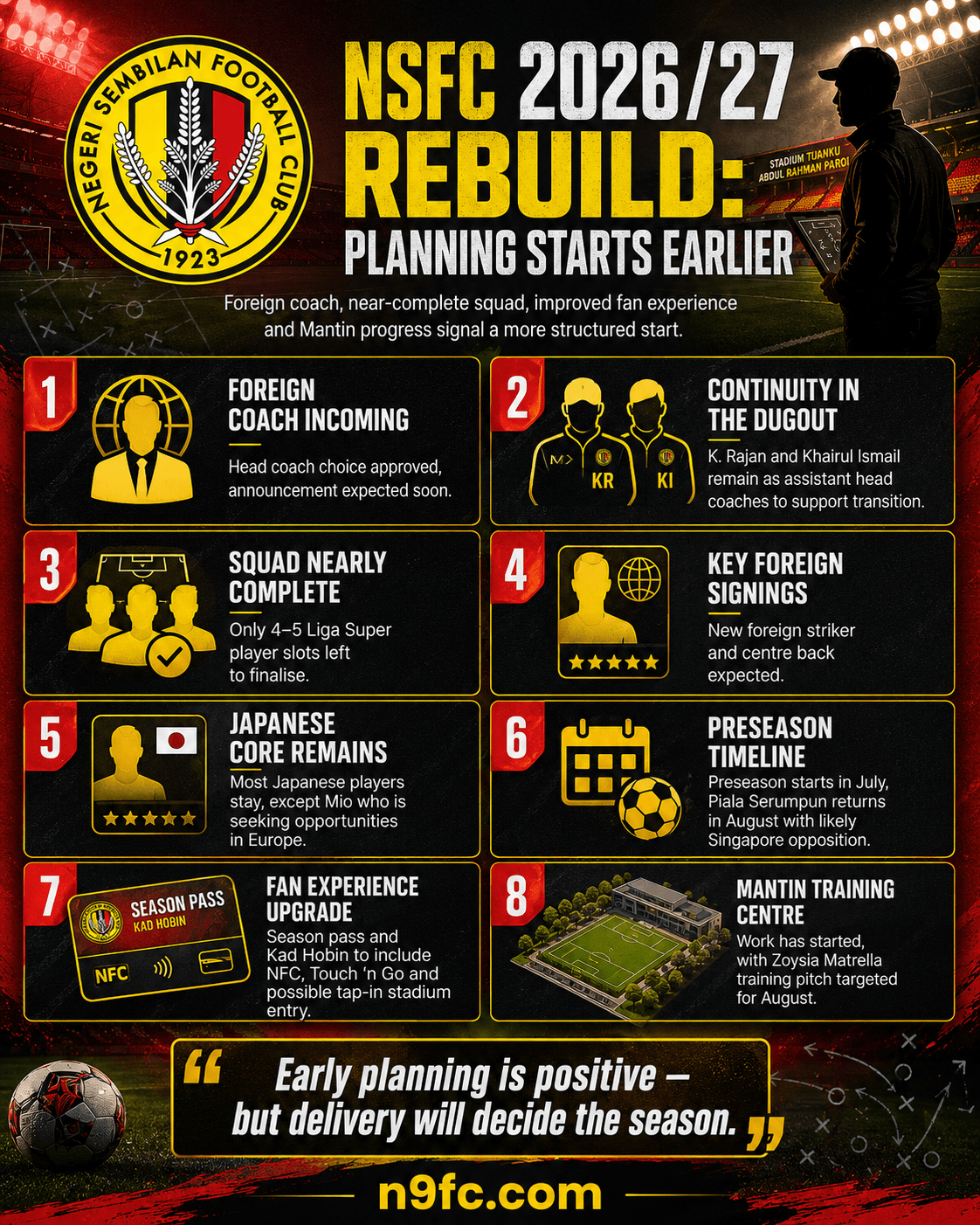
According to recent comments by NSFC Chief Executive Officer Faliq Firdaus Muhammad Rom, the club have received more than 30 applications for the head coach position, including candidates from Japan, Australia, Spain and Croatia, alongside local options. Evaluation and interview sessions are already underway, with the club’s technical director also involved in the process.

That detail matters.

This is not just a normal coaching vacancy. It is a signal that Negeri Sembilan FC are trying to make a more structured football decision, not simply appoint a name and hope for improvement. After a difficult season filled with pressure, inconsistency and rebuilding work, the next head coach will not only inherit a squad. He will inherit a project.

The big question now is clear: should NSFC go for a foreign coach with fresh tactical ideas, or choose local stability through someone who already understands Malaysian football?

The answer is not as simple as foreign versus local.

For Negeri Sembilan FC, the right appointment must be about fit, clarity and long-term direction.

A Coaching Search With Bigger Meaning

Faliq confirmed that planning for next season is already ongoing, with NSFC receiving applications from both foreign and local candidates. He also indicated that the club are still exploring whether to appoint an international or local coach, with the final decision expected to be made by club chairman and Negeri Sembilan Menteri Besar, Datuk Seri Aminuddin Harun, in May.

On the surface, this looks like a standard recruitment process. But for NSFC, the timing and context make it more significant.

The club are not starting from zero. Several key players are expected to remain, while around 70 percent of local players could be retained. Names such as Muhammad Azri Abdul Ghani and Luqman Hakim Shamsudin are expected to stay with the team, while import players including Takumi Sasaki and Jovan Motika are also set to remain.

That means the next head coach will not walk into a blank canvas. He will inherit a squad with existing strengths, weaknesses, personalities and expectations.

This is why the appointment must be handled carefully. A coach who wants a complete rebuild may not be the best fit if the club’s plan is to retain most of the local core. At the same time, simply keeping things comfortable without improving the playing structure would be a missed opportunity.

NSFC need evolution, not chaos.

Why The 2026/27 Appointment Matters More Than Usual

Every club says the next season is important. For Negeri Sembilan FC, that statement carries extra weight.

The club have spoken about the need for a structured playing system and a clear football philosophy. That suggests NSFC are not only looking for a motivator or short-term firefighter. They want a coach who can work within a defined football structure.

This is a positive sign, but only if the execution is serious.

Too many clubs talk about “philosophy” without actually building one. A real football philosophy must influence recruitment, training, player development, match preparation and even youth progression. It cannot be just a nice phrase used during press conferences.

If Negeri Sembilan want a more organised football identity, the next head coach must be someone who can translate that idea into visible performances.

Fans should be able to see it on the pitch. How does the team build from the back? How do they press? How do they defend transitions? How do they create chances? What type of midfield structure do they use? How do the wingers and full-backs combine? What is the role of the striker?

These are not abstract coaching theories. These are the details that decide whether a team looks organised or confused.

For NSFC, this appointment could shape not only next season’s results, but the club’s football direction for several years.

The Case For A Foreign Head Coach

There is a clear argument for appointing a foreign coach.

With applications reportedly coming from Japan, Australia, Spain and Croatia, NSFC may have access to candidates from different football cultures. Each background could offer something useful.

A Japanese coach may bring discipline, structure, technical repetition and collective organisation. A Spanish coach may bring a stronger focus on possession, positional play and ball circulation. An Australian coach may offer physical intensity, directness and competitive mentality. A Croatian coach may bring technical development, tactical discipline and strong player education.

Of course, nationality alone does not guarantee quality. A poor foreign coach is still a poor coach. But a good foreign appointment could help NSFC modernise their football environment.

A foreign coach may introduce new standards in training intensity, video analysis, fitness preparation, pressing structure, recovery methods and tactical planning. This could be especially useful if the club are serious about creating a more professional technical setup.

The biggest benefit of a foreign coach is not simply that he is foreign. It is that he may bring outside thinking.

Sometimes, a club needs someone from outside the local ecosystem to challenge old habits. If NSFC want to move beyond survival mode and become more competitive, fresh methodology could help.

But there is a serious risk.

A foreign coach who does not understand Malaysian football can struggle quickly. Liga Malaysia has its own realities: climate, pitch conditions, travel demands, squad depth limitations, refereeing patterns, budget restrictions and dressing-room culture. A coach who arrives with a rigid system and no local adaptation could fail, even if his CV looks impressive.

This is where NSFC must be sharp. They should not be blinded by passport or reputation. The club must ask harder questions.

Has the coach worked in a developing football environment before? Can he adapt to limited resources? Does he improve players, or does he only succeed with ready-made squads? Can he communicate clearly with local players? Is he willing to collaborate with the technical director?

A foreign coach could be a smart move, but only if he fits the project.

The Case For Local Stability

The case for a local coach is just as valid.

A local coach, or at least a coach with strong Malaysian football experience, would understand the league immediately. He would know the tempo, the travel, the opponents, the player market and the pressure from supporters. He would not need months just to learn how football works here.

That matters because NSFC cannot afford a slow start caused by adjustment problems.

Local stability can also help with communication. Malaysian dressing rooms often require more than tactical instruction. They require man-management, cultural understanding and emotional intelligence. A coach who understands the local football environment may be able to connect with players faster.

This is where K. Rajan’s continued role becomes important.

Faliq has stated that Rajan remains part of the club’s long-term plans and will stay within the coaching setup next season. That is a sensible decision if the club handles it properly. Rajan understands the squad, the internal environment and the difficulties the team went through. His presence can provide continuity during a transition period.

However, local stability cannot become an excuse for low ambition.

NSFC should not appoint a local coach simply because it feels safer. Safety without progress is not a strategy. The next coach must still bring tactical clarity, modern training standards and the ability to improve players.

A local appointment can work, but only if the coach has more than league familiarity. He must have a clear game model and the authority to push the team forward.

The Real Question Is Not Foreign Or Local

The debate should not be reduced to “foreign coach good” or “local coach safe”.

That is too shallow.

The real question is this: which candidate best fits Negeri Sembilan FC’s football direction?

The next head coach must align with the club’s technical director, recruitment plan, retained squad profile and long-term playing philosophy. If the club have already established a structure, then the coach must be able to work within it rather than tear everything apart.

This is where many football clubs get appointments wrong. They appoint a coach based on name, emotion or short-term pressure, then realise the squad does not suit his system. The result is predictable: poor performances, panic signings, confused players and another reset before the season is even over.

NSFC cannot afford that cycle.

With around 70 percent of local players expected to remain, the club need a coach who can improve what already exists. He must identify which players can be developed, which positions need upgrading and which tactical system brings the best out of the squad.

The new coach must not arrive with a fantasy version of football that ignores the players available. He must be ambitious, but realistic.

What Kind Of Coach Should NSFC Choose?

Negeri Sembilan FC should be looking for six key qualities.

First, the coach must have tactical clarity. He needs to know exactly how he wants the team to play in possession, out of possession and during transitions. NSFC cannot afford vague football. The players must understand their roles.

Second, he must be adaptable. A good coach has principles, but he does not force unsuitable tactics onto unsuitable players. If the squad is built around certain strengths, the coach must use them intelligently.

Third, he must have a development mindset. NSFC need someone who can improve local players, not simply complain about limitations. If the club are retaining a large local core, player development becomes essential.

Fourth, he must work well with the technical director. Modern football cannot depend on one powerful head coach doing everything alone. Recruitment, analysis, youth development and performance planning must be connected.

Fifth, he must have dressing-room authority. This does not mean shouting louder than everyone else. It means earning respect through clear communication, consistency and standards.

Sixth, he must understand realistic ambition. Negeri Sembilan FC supporters want progress, but progress must be built properly. The club need visible improvement, not empty promises.

K. Rajan’s Role Could Be Crucial

One of the more interesting parts of this situation is Rajan’s expected continuation within the coaching setup.

This could be a major advantage if managed correctly.

Rajan can help the new head coach understand the squad faster. He can provide insight into local players, internal dynamics and the challenges faced last season. He can also support the transition so the team does not lose continuity overnight.

But there is one important condition: the roles must be clear.

If NSFC appoint a new head coach, that coach must have authority over the team. Rajan’s role should support the structure, not create confusion. The same applies to the technical director. Everyone must know who makes which decisions.

A good football structure is not about collecting titles. It is about clear responsibility.

If the club can define the head coach, assistant coaches and technical director roles properly, Rajan’s presence could become a strength. If not, it could create unnecessary uncertainty.

Player Retention Makes The Decision More Sensitive

The expected retention of a large part of the local squad changes the nature of the appointment.

If most of the core remains, the new coach must be selected based on whether he can work with that group. This does not mean accepting mediocrity. It means choosing a coach whose system fits the players NSFC are keeping.

For example, if Azri Ghani remains as the main goalkeeper, how does the new coach want to build from the back? If Luqman Hakim stays, what role suits him best? If Takumi Sasaki and Jovan Motika remain, how can the coach maximise their qualities within the attacking structure?

These are football questions that must be asked before the appointment, not after.

The worst-case scenario would be appointing a coach after player decisions have already been made, only to discover that the squad does not match his preferred style.

That would be poor planning.

The better approach is to ensure the coach, technical director and recruitment team are aligned early. If 30 percent of the squad will be replaced, those signings must be made with the playing system in mind.

NSFC do not need random recruitment. They need targeted recruitment.

What Fans Should Watch Closely

For supporters, the next few months will be important.

The identity of the next head coach will say a lot about what kind of club NSFC want to become. Fans should look beyond the headline name and ask more serious questions.

Does the coach have experience building a team structure? Does he improve young players? Are his teams defensively organised? Does he have a clear attacking pattern? Can he manage local and import players together? Does he work well within a technical department?

These are better questions than simply asking whether the coach is foreign or local.

A strong appointment may not always be the most glamorous one. Sometimes the best coach is not the biggest name, but the one whose methods fit the club’s real needs.

NSFC supporters have seen enough football to know that excitement in pre-season means nothing if the team has no structure once the league begins.

The Risk Of Getting It Wrong

The danger is obvious.

If Negeri Sembilan FC choose the wrong coach, the consequences could affect the entire season. A poor appointment can lead to a slow start, confused tactics, unhappy players, wasted signings and pressure from fans. Once that cycle begins, it is difficult to stop.

In Malaysian football, clubs often do not get much time to correct mistakes. A few bad results can change the mood quickly. That is why the decision before the season may be just as important as any signing.

The new head coach must not only survive pressure. He must give the team direction.

NSFC need a coach who can make the team harder to beat, better organised and more consistent. The supporters do not expect miracles overnight, but they deserve to see a team with purpose.

Conclusion: NSFC Must Choose Fit Over Hype

Negeri Sembilan FC’s next head coach decision should not be treated as a simple choice between a foreign coach and a local coach.

A foreign coach could bring fresh ideas, stronger methodology and a new football culture. A local coach could bring league knowledge, smoother adaptation and dressing-room stability. Both routes can work. Both can also fail.

The deciding factor must be fit.

NSFC need a coach who understands the club’s direction, works with the technical director, improves the retained squad and builds a clear playing identity. With key players expected to stay and recruitment already part of the planning, this is not the time for a careless appointment.

The next coach must not be chosen for glamour. He must be chosen because he can build.

For Negeri Sembilan FC, this decision is about more than who stands on the touchline in 2026/27. It is about what kind of football future the club wants to create.

K. Rajan Set to Remain With Negeri Sembilan FC After Strong Unbeaten Finish

Negeri Sembilan FC interim head coach K. Rajan looks set to continue his journey with the club as preparations begin for the upcoming 2026/2027 Malaysia League campaign.

The 45-year-old coach confirmed that he has been informed by the club management that he remains part of NSFC’s plans for next season. However, his official role within the team has yet to be finalised.

Speaking to reporters after the Malaysia Super League match at Stadium Tuanku Abdul Rahman, Paroi, Rajan expressed his gratitude to the club for continuing to place trust in him.

“I have been informed by the club management that I am included in their plans and will remain with the team for next season’s campaign.

“However, in terms of my position within the team, that has not been determined yet. We will wait for the official announcement. I would like to thank the club for giving me the opportunity to continue contributing to this team,” said Rajan.

Rajan was appointed to take charge of the team following the resignation of Nidzam Jamil in mid-February. Since stepping into the role, he has helped steady the squad and guide Negeri Sembilan FC through a much-improved run of form.

Under his leadership, the Hobin Jang Hobin squad ended the league campaign unbeaten in their final eight matches, a strong response after a challenging period earlier in the season.

Reflecting on the team’s performance, Rajan said he was pleased with the progress shown by the players, coaches and support staff.

“I think this is a good result. Finishing seventh in the league this season is also better than last season’s 12th-place finish. We have to give credit to the players, coaches and support staff,” he said.

The improvement is a significant boost for NSFC as the club now turns its attention towards building a stronger foundation for the 2026/2027 season.

While the official structure of the coaching team has yet to be announced, Rajan’s expected continuation offers a sense of stability for Negeri Sembilan FC. His familiarity with the squad, recent unbeaten momentum and understanding of the club’s environment could prove valuable as the team prepares for the next phase.

For the supporters, the message is clear: NSFC ended the season with belief, resilience and progress. The challenge now is to turn that late-season momentum into a more consistent campaign when the new Malaysia League season begins.

With several key decisions still to come, including coaching roles, squad planning and player evaluation, Negeri Sembilan FC appear to be taking early steps towards a more competitive future.

For now, K. Rajan’s continued presence is a positive sign that the club wants to build on what worked — not start again from zero.

Jovan Motika Embraces Negeri Sembilan Colours After Confirmed Contract Extension

Negeri Sembilan FC forward Jovan Motika has given supporters another reason to smile after sharing an emotional Instagram post celebrating his continued journey with the club.

The Bosnia and Herzegovina attacker, who has already been confirmed as one of four import players to sign new deals with NSFC, posted a striking graphic featuring himself in Negeri Sembilan colours alongside the bold text “Jovan Motika 9” and “2028”.

His caption captured the mood perfectly:

“Jatuh cinta dengan warna-warna ini, jumpa lagi musim depan 💛🖤❤️
✌️ lebih banyak”

In English, the message can be understood as: “Fell in love with these colours, see you again next season. More to come.”

For the Jang faithful, it was more than just a social media update. It was a clear message of affection, belief and ambition from a player who appears to have fully embraced the identity of Negeri Sembilan FC.

Motika’s extension was confirmed earlier as part of NSFC’s early preparations for the 2026/27 season, with the club also retaining Takumi Sasaki, Kei Oshiro and Yuichi Hirano. According to NSFC Chief Executive Officer Faliq Firdaus, all four players recently agreed to extend their contracts with the club as Negeri Sembilan look to build continuity rather than start from scratch. 

That decision is significant. Motika finished as one of NSFC’s key attacking contributors, with N9FC.com’s player ranking table listing him among the club’s leading scorers for the season. His return gives the team an important attacking option heading into a campaign where stability and smarter squad planning will be crucial.

The Instagram post also reflects something supporters value deeply: connection. Players come and go in modern football, especially foreign imports, but Motika’s words suggest he has developed a genuine attachment to the club’s colours — yellow, black and red — and to the journey being built in Negeri Sembilan.

The phrase “lebih banyak”, meaning “more”, will naturally excite fans. It hints at unfinished business, greater motivation and a desire to deliver stronger performances next season.

For NSFC, keeping Motika is not only a footballing decision. It is also a statement of direction. The club has made it clear that it wants to retain a strong core from the current squad, with Faliq previously stating that Negeri Sembilan are looking to keep around 70 percent of the team for the 2026/27 league season. 

After a season filled with challenges, that continuity could become one of the foundations for a better campaign ahead.

For now, Motika’s message is simple but powerful: he is staying, he has embraced the colours, and he wants more.

For the Jang supporters, that is exactly the kind of signal they want to see before the next chapter begins.