

Football seasons are often remembered through emotions. A late goal, a painful defeat, a packed stadium, a controversial decision or a moment of individual brilliance can shape how supporters feel about a campaign.
But numbers tell a different kind of story. They do not capture everything, but they do show patterns. They reveal whether a team was truly competitive, where it improved, where it struggled and what must change next.
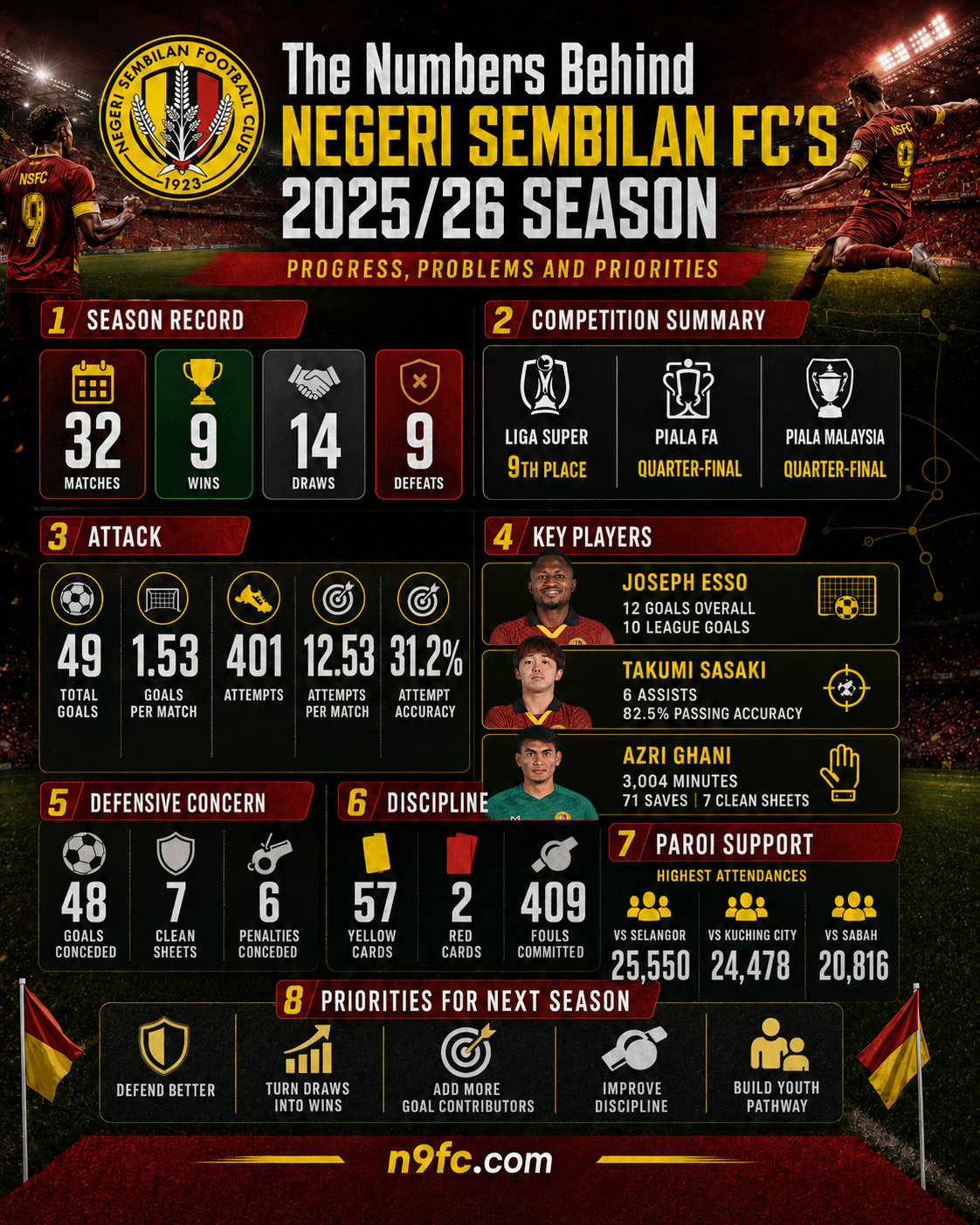
For Negeri Sembilan FC, the 2025/26 season was not a simple story of failure or success. It was somewhere in between. The Jangs played 32 matches, won 9, drew 14 and lost 9. They finished 9th in Liga Super, reached the quarter-finals of both the Piala FA and Piala Malaysia, scored 49 goals and conceded 48.
Those numbers show a team that was competitive enough to stay in games, but not sharp enough to turn enough of them into wins. There was progress, but there were also clear problems. More importantly, there are obvious priorities if Negeri Sembilan want to take a bigger step next season.
A Season Defined By Fine Margins
The first number that stands out is the balance of the record: 9 wins, 14 draws and 9 defeats from 32 matches.
At first glance, that record shows stability. Negeri Sembilan were not a team collapsing week after week. They did not lose more games than they won. They were involved in many close contests and remained competitive across different competitions.
But the problem is also obvious. Fourteen draws is a lot.
A team that draws too often usually has one of several issues. It may struggle to kill games off after taking control. It may lack enough attacking sharpness in key moments. It may concede at the wrong time. Or it may be tactically solid enough to avoid defeat, but not dominant enough to impose itself consistently.
For NSFC, the issue was not simply losing too often. The bigger issue was not winning enough of the matches that were there to be taken.
This is where the season becomes frustrating. A few extra wins could have changed the mood around the league campaign. Turning just three or four draws into victories would have made the final position look very different. That is why the next step is not only about signing better players. It is about improving game management, mentality and efficiency.
League Position And Cup Runs: Stable, But Not Yet Enough
Finishing 9th in Liga Super is not disastrous, but it cannot be dressed up as a major success either.
For a club like Negeri Sembilan FC, with a strong identity, loyal supporters and a proud football culture, the aim has to be higher than survival or mid-table comfort. The 2025/26 campaign showed that NSFC could compete, but it also showed that the team still lacks the consistency required to push into a stronger position.
The cup performances were more encouraging. Reaching the quarter-finals of both the Piala FA and Piala Malaysia shows that Negeri Sembilan had enough quality to survive knockout pressure and give fans meaningful matches beyond the league campaign.
Cup runs matter because they build belief. They give supporters nights to remember and players moments to prove themselves. But cups can also hide league weaknesses. A team can perform well in one-off matches but still struggle with weekly consistency.
That was the main story of Negeri Sembilan’s season: good enough to compete, not consistent enough to climb.
Attack: Respectable Output, But Room For More Ruthlessness
Negeri Sembilan scored 49 goals across the season, averaging 1.53 goals per match. That is not a poor attacking return. In fact, it suggests that NSFC had enough going forward to trouble opponents.
The team also recorded 401 total attempts, with an average of 12.53 attempts per match. That tells us Negeri Sembilan were not passive. They were able to get shots away and create attacking situations regularly.
However, the attempt accuracy of 31.2% points to an important area for improvement. Creating chances is only one part of the job. Making those chances count is what separates a competitive team from a dangerous one.
The variety of goals is also interesting. Negeri Sembilan scored 9 headed goals, 7 goals from outside the box, 4 penalties, 2 direct free-kick goals, 6 goals from corners and 6 goals from open play situations listed as sudut. These numbers show that the team did not rely on just one route to goal. There was threat from set-pieces, distance, crosses and individual moments.
But the question for next season is whether NSFC can create a more repeatable attacking system. Goals from outside the box and set-pieces are valuable, but a stronger team needs regular, high-quality chances from structured attacking play.
The attack had volume. The next step is precision.
Joseph Esso Remained The Main Goal Threat
Joseph Esso finished as Negeri Sembilan’s top scorer with 12 goals overall and 10 goals in the league. That is a strong individual return and proves his importance to the team.
In a season where many matches were decided by fine margins, having a reliable goal threat mattered. Esso gave NSFC a focal point and a player capable of turning attacking moves into actual results.
But his numbers also highlight a wider issue. When one player carries a large share of the scoring responsibility, the team can become predictable. Opponents know where the main danger comes from. If Esso is marked tightly, isolated or having an off day, NSFC need other players to step forward.
Next season, Negeri Sembilan need more goals from midfield, wide areas and defenders at set-pieces. Esso’s contribution should be a foundation, not a burden.
A stronger supporting cast would make the attack more balanced and harder to read.
Takumi Sasaki’s Creative Influence Was Clear
Takumi Sasaki led the team in assists with 6 and also recorded an 82.5% passing accuracy. Those two numbers say a lot about his value.
He was not only providing final passes. He was also helping the team keep rhythm in possession. Passing accuracy matters because it reflects control, decision-making and technical reliability. In matches where NSFC needed calmness, Sasaki provided an important link between phases of play.
But just like with Esso’s goal numbers, Sasaki’s creative influence raises a bigger question: did Negeri Sembilan have enough creators?
A team aiming to climb the table cannot rely on one main source of creativity. It needs multiple players capable of opening opponents, delivering quality final balls and changing the tempo of matches.
Sasaki’s season deserves credit. But NSFC must make sure he is supported by more creative options next season.
Azri Ghani’s Reliability Stood Out
Azri Ghani’s 3,004 minutes played made him the player with the highest minutes for Negeri Sembilan. For a goalkeeper, that kind of availability is extremely valuable.
He also recorded 71 saves and 7 clean sheets. Those numbers underline his importance throughout the campaign. A goalkeeper who plays consistently and delivers saves gives the team stability.
However, the number of saves also tells another story. Azri was busy. Too busy at times.
A strong goalkeeper can protect a team, but he should not have to rescue the team every week. The best defensive improvement is not only about the goalkeeper making more saves. It is about reducing the number of dangerous situations he has to face.
Azri’s reliability was one of the positives of the season. The challenge for the team is to protect him better.
The Defensive Record Must Improve
The most concerning number in the whole season may be this: 48 goals conceded.
When a team scores 49 and concedes 48, the margin is simply too thin. It means the attack did just enough to keep the team competitive, but the defence did not provide enough control to turn competitiveness into consistent results.
Seven clean sheets from 32 matches is useful, but not enough for a team that wants to move up the table. Clean sheets are not just defensive statistics. They are the foundation for winning seasons. A team that keeps more clean sheets gives itself a chance to win even when the attack is not at its best.
The 6 penalties conceded are another warning sign. Penalties are often caused by poor positioning, late reactions, pressure inside the box or bad decision-making. Some may be unlucky, but over a season the pattern matters.
If Negeri Sembilan want to improve next season, defensive organisation must be the biggest priority. That includes the back line, midfield protection, pressing structure, communication and concentration during key moments.
The goal cannot only be to score more. The goal must be to concede less.
Discipline Also Came At A Cost
Negeri Sembilan committed 409 fouls, received 57 yellow cards and 2 red cards. Harith Samsul had the highest number of bookings with 5 yellow cards.
Discipline is sometimes discussed only when a player is sent off, but that is too narrow. Yellow cards affect how players defend. Fouls break rhythm. Suspensions disrupt team selection. Repeated defensive fouls also show that a team is often reacting instead of controlling.
This does not mean NSFC should lose aggression. Football needs intensity. But controlled aggression is very different from unnecessary fouling.
A more organised team usually commits fewer desperate fouls because players are already in better positions. That is why discipline is linked to structure. Improve the structure, and the card count should naturally reduce.
Young Players Need A Clearer Pathway
The youngest players to feature included Noor Aidil, aged 21, and Haiqal Danish, who appeared against Selangor FC. That is a positive sign. A club like Negeri Sembilan should always create space for young players to grow.
But youth involvement cannot be symbolic. It must be part of a clear development plan.
Giving young players minutes is only the first step. The bigger question is whether the club can build a proper pathway from youth football to senior football. Young players need coaching, competitive exposure, physical development and trust.
If NSFC can develop more local players who are ready for first-team responsibility, the club will gain both sporting and financial value.
Paroi Remains A Major Strength
One of the strongest positives from the season was the support at Stadium Tuanku Abdul Rahman, Paroi.
The highest attendances were impressive: 25,550 against Selangor, 24,478 against Kuching City and 20,816 against Sabah. These are not small numbers. They show that Negeri Sembilan FC still have a powerful base when supporters believe there is something worth turning up for.
Paroi can still be one of the club’s biggest advantages. The atmosphere, identity and loyalty are there.
But strong support should not be taken for granted. Fans need to see ambition. They can accept rebuilding. They can accept difficult moments. But they must see direction.
If the team becomes more consistent, Paroi can become an even stronger weapon.
Priorities For Next Season
The numbers make Negeri Sembilan’s priorities clear.
First, the defence must improve. Conceding 48 goals is too many for a team aiming to climb. NSFC need better structure, fewer penalties conceded and more clean sheets.
Second, the team must turn draws into wins. Fourteen draws show that Negeri Sembilan were close in many matches, but closeness is not enough. Better finishing, stronger substitutions, calmer game management and sharper late-match concentration can make a major difference.
Third, the attack needs more contributors. Joseph Esso delivered, but he needs support. Goals must come from more positions.
Fourth, creativity must be shared. Takumi Sasaki was important, but NSFC need more players who can create chances and control attacking phases.
Fifth, discipline must improve. Fewer unnecessary fouls and cards will help the team control matches better.
Finally, youth development must become more than just giving debuts. The club needs a pathway that produces players capable of becoming regular first-team options.
Progress Is Real, But The Next Step Must Be Bigger
Negeri Sembilan FC’s 2025/26 season was not empty. There were positives: cup quarter-finals, strong support at Paroi, a reliable goalkeeper, a proven scorer, a creative influence in midfield and a team that was rarely completely out of contests.
But the numbers are honest. They show a team with potential, but also a team that must become sharper, more disciplined and more consistent.
The Jangs were competitive. Now they must become more decisive.
For Negeri Sembilan FC, the next step is clear. Score with more efficiency. Defend with more authority. Manage matches with more maturity. Build a squad with more balance. Give young players a real pathway.
The 2025/26 numbers should not be seen only as a review of the past. They should be used as a guide for the future.
Progress exists, but progress alone is not enough. The priority now is turning that progress into results.