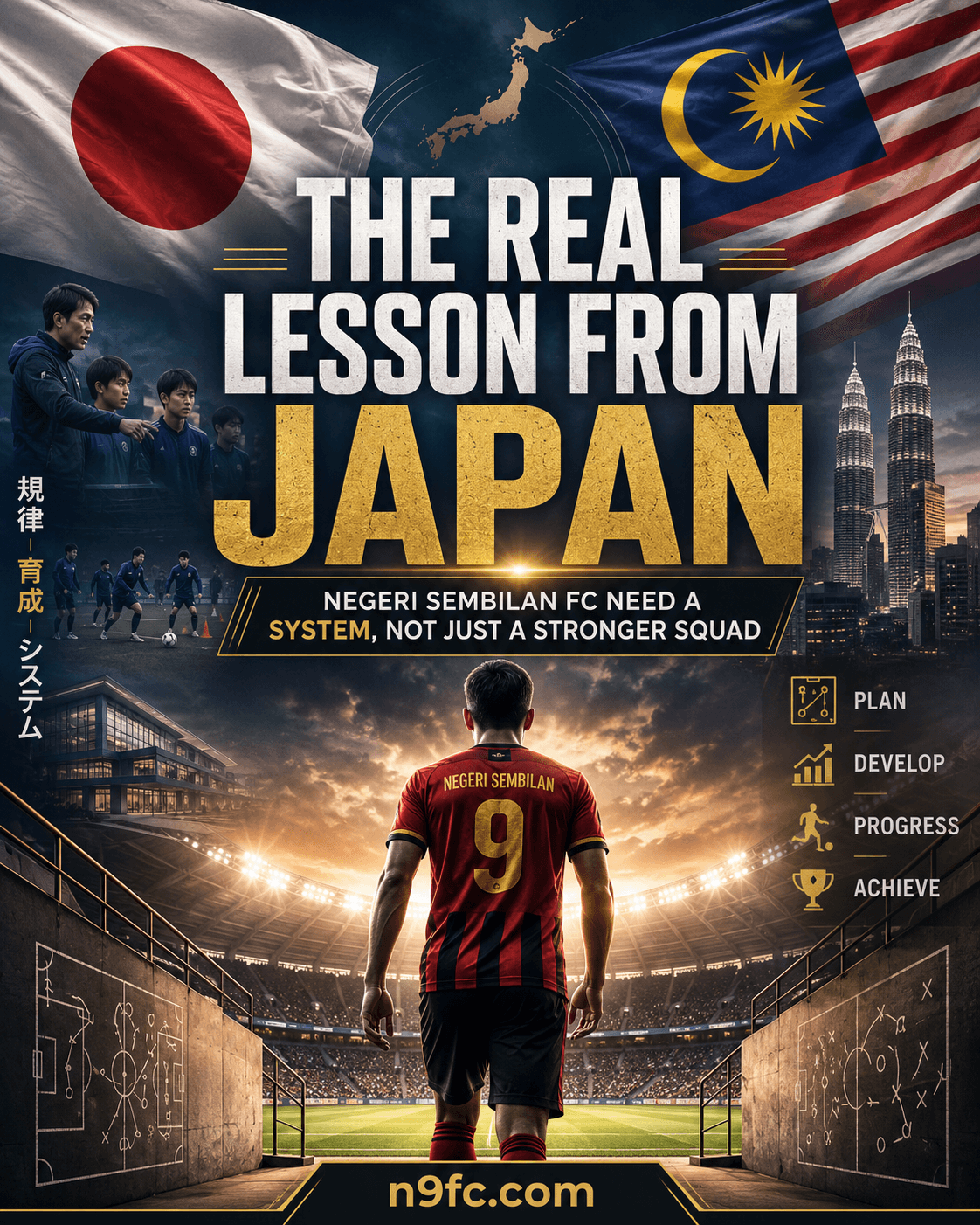

Negeri Sembilan FC’s next step forward will not be decided by one signing, one coach, one foreign player, or one good transfer window.
Those things matter, of course. A better squad can improve results. A stronger coach can bring better organisation. A few smart signings can change the mood around the club. But if Negeri Sembilan FC truly want to move beyond short-term survival and become a more stable, competitive football club, the bigger question is this:
Does NSFC have a proper football system?
That is the real lesson worth taking from Japan.
Recently, Faliq Firdaus shared his experience after attending a course with the J-League, Japan FA, and representatives from several major Japanese clubs including Gamba Osaka, Urawa Red Diamonds, Vissel Kobe, Yokohama F. Marinos and others at the J-League office in Tokyo.
His reflection was simple but important. Japan’s football success is not built overnight. It is built through patience, planning, shared direction and proper structure.
For Negeri Sembilan FC, that message should not be treated as just another motivational takeaway. It should be treated as a serious football lesson.
Because the gap between a club that only signs players and a club that builds a system is massive.
Japan’s Football Growth Was Not An Accident
The J-League started in 1993 with only 10 teams. Today, according to Faliq’s sharing, the wider J-League structure has grown to around 60 teams.
That growth did not happen by luck.
Japan did not become one of Asia’s strongest football nations simply because they had talented players. Talent was only one part of the story. The bigger difference was the ecosystem built around that talent.
They developed clubs. They improved competitions. They created clearer youth pathways. They invested in coaching. They studied data. They linked football ambition with commercial planning. They gave clubs a structure to grow.
That is why Japan’s football model is often respected across Asia. It is not perfect, but it is organised. More importantly, it understands that football progress needs time.
This is a lesson Malaysian football often struggles to accept.
Too many clubs want quick success. New coach, new imports, new slogan, new target. Then when results do not come fast enough, the cycle starts again. Another reset. Another rebuild. Another season of “we need time”.
Japan’s lesson is different. Progress requires a long-term plan that survives beyond one season.
The Most Important Word: Alignment
One of the strongest points from Faliq’s post was this: everyone must be aligned.
In Malay, the phrase “sehati dan senada” captures it perfectly.
A football club cannot grow properly if every department moves in a different direction. The management may want one thing, the head coach may want another, the academy may operate separately, the commercial team may have no connection to football objectives, and fans may be left guessing what the club is actually trying to build.
That kind of environment creates confusion.
For Negeri Sembilan FC, alignment should mean several things.
The club leadership must know what kind of football direction they want. The coaching staff must fit that direction. Recruitment must support that football idea. Youth development must prepare players for the senior team, not exist only as a separate programme. Commercial planning must strengthen the football operation. Communication with supporters must be clear enough for fans to understand the process.
Without alignment, every season becomes reactive.
If the team struggles, the first answer becomes “change the coach”. If the attack is weak, the answer becomes “sign a striker”. If young players do not break through, the answer becomes “they are not ready”. Some of those answers may be partly true, but they do not solve the bigger issue.
The bigger issue is whether the club is functioning as a joined-up football organisation.
A Stronger Squad Helps. A Stronger System Lasts.
Negeri Sembilan FC fans naturally want better players. That is normal. Football is emotional. Supporters want to see quality imports, reliable local players, strong defenders, creative midfielders and clinical finishers.
But a stronger squad alone is not enough.
A good squad can improve one season. A good system can improve five seasons.
This is where NSFC must be honest with itself. If recruitment is not connected to a clear playing style, the club will keep signing players based on short-term needs. If coaching changes disrupt the whole football direction, the team will keep starting again. If youth development is not connected to the first team, young players will continue to struggle for a real pathway.
A football system gives the club continuity.
It helps the club answer important questions:
- What style of football should Negeri Sembilan FC play?
- What type of players fit that style?
- What kind of coach fits the club’s direction?
- Which academy players are being prepared for senior football?
- What positions should the club develop internally?
- What areas require outside recruitment?
- How does the club measure progress beyond league position?
Without these answers, a club can spend money and still stand still.
That is why the real issue is not only whether NSFC can build a stronger squad. The real issue is whether NSFC can build a stronger football structure behind that squad.
The Honest Benchmark: Where Does NSFC Really Stand?
Faliq’s reflection included a very honest point: in terms of size and operation, Negeri Sembilan FC may be closer to a J3 or JFL-level club in Japan’s football structure.
Some fans may not like hearing that. But it should not be taken as an insult.
In fact, it may be one of the most useful observations.
A club cannot improve if it does not understand its real level. Overestimating your structure is dangerous. It leads to unrealistic expectations, poor planning and emotional decision-making.
If NSFC’s current operation is closer to a lower-division Japanese club, then the club should study what those clubs do well. How do they control costs? How do they develop players? How do they grow commercial revenue? How do they use their community? How do they build a clear football identity despite limited resources?
There is no shame in starting from a realistic benchmark.
The danger is pretending to be bigger structurally than the club actually is.
Negeri Sembilan FC have history, identity and passionate supporters. But modern football is not powered by history alone. It requires competent administration, sustainable finances, smart football planning, strong local talent development and proper performance management.
The club has potential. But potential only matters if it is organised.
What A Proper NSFC System Should Look Like
If Negeri Sembilan FC want to learn seriously from Japan, the club does not need to copy the J-League blindly. That would be unrealistic.
Malaysia has different economics, different football culture, different governance problems and different competition structures.
But NSFC can still adapt the principles.
A proper club system should include several core pillars.
1. A Clear Playing Identity
Negeri Sembilan FC need to know what kind of football they want to play.
This does not mean every coach must use the exact same formation forever. Football must remain flexible. But the club should have a broad identity.
Does NSFC want to be a high-pressing team? A compact counter-attacking team? A possession-based team? A physically aggressive team? A development-focused team that gives minutes to younger players?
Once the identity is clearer, recruitment becomes smarter.
The club stops signing random players and starts signing players who fit specific roles. The academy can also prepare young players based on the same football principles.
Without identity, recruitment becomes guesswork.
2. Smarter Recruitment
A serious club does not sign players only because they are available, popular, familiar or recommended by agents.
Recruitment should be based on role, data, character, injury record, tactical fit and squad balance.
For NSFC, this is especially important because the club cannot afford too many mistakes. Bigger clubs may survive poor signings because they have deeper budgets. Smaller clubs suffer badly when recruitment goes wrong.
A smart recruitment structure should ask:
- Does this player fit the coach’s tactical plan?
- Does he solve a real squad problem?
- Is his injury record acceptable?
- Does his salary make sense?
- Is he blocking a young player who could be developed?
- Can he improve the team immediately?
- Can he still contribute beyond one season?
Recruitment is not just about finding good players. It is about finding the right players for the club’s direction.
3. A Real Youth Pathway
Youth development is not just about having youth teams.
The real question is whether there is a pathway.
A pathway means the club can clearly identify how a player moves from school football or grassroots level into youth teams, then into development squads, then toward the senior team.
Faliq mentioned that Japanese development teams at U18, U15 and U12 levels often compete regionally according to their areas, helping to control development costs.
This is highly relevant to Negeri Sembilan.
NSFC should not only think about youth development as a branding exercise. It should become a serious football pipeline. The club should strengthen relationships with schools, local academies, district football structures and youth competitions.
A state like Negeri Sembilan should be able to create a clearer local talent ecosystem.
The aim should not be to produce one star by luck. The aim should be to create a repeatable pathway that produces players consistently.
4. Better Development Competition
One of the problems in football development is the gap between youth football and senior football.
Many young players look promising at youth level but struggle to break into senior teams because the jump is too big. They need competitive minutes, physical exposure, tactical learning and pressure situations.
That is why development leagues, reserve teams, B-teams or structured youth competitions are important.
Faliq mentioned that the J-League is looking at a B21 league involving 10 teams. Whether Malaysia should copy that exact model is another debate. But the principle is important.
Young players need proper matches.
Training alone is not enough. Friendly games are not enough. Sitting on the bench is not enough.
For NSFC, this raises a serious question: how can the club create more meaningful competitive minutes for its young players?
If there is no bridge between youth and senior football, many talents will continue to disappear before they mature.
5. Coach Development
Players are not the only ones who need development. Coaches do too.
If NSFC want a long-term system, the club must also invest in coaching knowledge. This includes senior coaches, assistant coaches, youth coaches, goalkeeper coaches, fitness coaches and analysts.
A club’s football culture is shaped by its coaches.
If coaches are not aligned, the development pathway breaks. If youth coaches teach one style and the senior team plays another, players struggle to adapt. If assistant coaches are not empowered, knowledge does not grow internally.
Japan’s model shows the value of learning and sharing. Faliq’s post itself is proof that exposure matters.
But exposure must lead to implementation.
The question is not only who attends courses. The question is what changes after they return.
6. Data And Performance Analysis
Football is still a human game. Data cannot replace judgement.
But modern clubs cannot ignore data.
Faliq highlighted that Japanese research over 13 years showed strong correlations involving team spending, success, office staff expenditure and club sales.
That point matters because it shows football performance is not isolated from the rest of the organisation.
For NSFC, data should not only mean match statistics. The club should be tracking player minutes, injuries, physical output, recruitment efficiency, youth progression, attendance, fan engagement, sponsorship performance and commercial growth.
A serious club uses data to ask better questions.
Why are certain players injured often? Which positions are consistently weak? Which youth players are improving fastest? Which signings give the best value? Which fan engagement activities increase attendance or merchandise sales?
Data does not guarantee success. But without data, too many decisions depend on instinct alone.
7. Commercial And Administrative Strength
This is the part many fans overlook.
A football club is not only 11 players on the pitch. It is also an organisation.
Office staff, sponsorship teams, media teams, ticketing operations, merchandising, community engagement, finance, matchday operations and digital content all affect the club’s growth.
A club with weak administration will eventually struggle on the pitch.
Why? Because football needs money, planning and execution.
If commercial growth is weak, the football budget suffers. If media output is poor, the club loses attention. If ticketing and matchday experience are weak, fan connection drops. If sponsorship management is poor, revenue opportunities disappear.
For NSFC, this is a major area of potential.
The club has a clear identity, a loyal fanbase and a state football culture. But these assets must be organised properly. Passion alone does not generate sustainable revenue. It must be converted into membership, tickets, merchandise, sponsorship, digital reach and community connection.
The Next Season Must Be More Than Another Rebuild
Looking ahead, Negeri Sembilan FC’s next phase should not only be about assembling a stronger squad for one campaign.
The club must think deeper.
The head coach decision should fit the long-term football direction. Contract renewals should reflect squad planning, not just emotion. Foreign player recruitment should be based on role and tactical fit. Local signings should improve depth and balance. Youth players should be given a realistic development route.
Most importantly, the club must communicate its direction more clearly.
Fans do not need every internal detail. But supporters deserve to understand what kind of club NSFC are trying to become.
Are we building around youth? Are we targeting gradual league improvement? Are we creating a specific playing identity? Are we strengthening the academy? Are we improving commercial operations? Are we trying to become a more self-sustaining club?
Clear direction creates patience.
When fans see a real plan, they are more likely to support the process. But when everything looks reactive, frustration grows quickly.
The Risk: Learning From Japan But Doing Nothing
There is one uncomfortable truth.
Malaysian football has never lacked ideas. There have been many courses, visits, seminars, development plans and foreign models studied over the years.
The problem is implementation.
It is easy to admire Japan. It is easy to say “we should learn from them”. It is easy to come back inspired.
The harder part is changing how the club actually works.
If NSFC truly want to take lessons from Japan, the club must turn learning into action. Not vague action. Real action.
Set a football direction. Build a recruitment framework. Strengthen youth links. Improve coaching alignment. Track performance data. Grow commercial operations. Communicate the plan.
That is how a club moves from inspiration to progress.
Otherwise, the Japan lesson becomes just another nice story.
Build The Club, Not Just The Team
Negeri Sembilan FC do not need to become a J-League club overnight. That would be unrealistic.
But NSFC can learn the deeper lesson.
Football progress is not built only by chasing better players every season. It is built by creating a system where every part of the club supports the same objective.
Management, coaching, recruitment, youth development, data, commercial planning, administration and fan engagement must move together.
That is what separates a club with short-term ambition from a club with a real future.
For Negeri Sembilan FC, the challenge is clear. The club can continue treating every season as another rebuild, or it can start building something more permanent.
A stronger squad may win matches.
But a stronger system can build Negeri Sembilan FC for the next decade.