
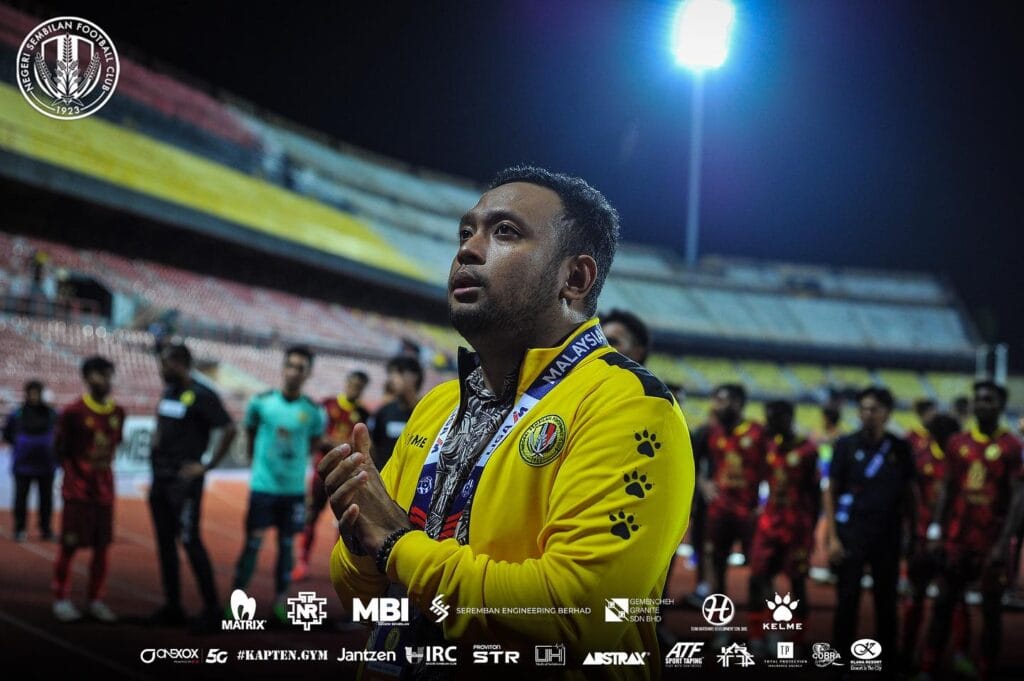
Negeri Sembilan FC (NSFC) Chief Executive Officer Faliq Firdaus has provided a comprehensive explanation behind the club’s decision not to field a team in the Piala Belia (U18) competition—framing it as a calculated, long-term move to strengthen the club’s elite development pathway and financial sustainability.
In a detailed statement, Faliq highlighted that NSFC currently operates eight teams across various levels, far exceeding the minimum five teams required under AFC club licensing regulations. These include the senior squad in the Malaysia Super League, Liga A1, President’s Cup (largely U18), and multiple grassroots squads from B-17 down to B-10, including a women’s B-16 side.
A Clear Division of Roles
Faliq emphasised that NSFC and Negeri Sembilan FA (NSFA) have aligned their responsibilities to avoid duplication and maximise efficiency.
- NSFC will focus on elite talent development and end-product readiness, particularly at Liga A1 level
- NSFA will handle grassroots competitions and development platforms, including A3 leagues and youth tournaments
This structured separation ensures that both entities contribute effectively to the broader football ecosystem in Negeri Sembilan.
Why Skip Piala Belia?
The decision not to participate in Piala Belia was not taken lightly—but it is rooted in practical realities and performance outcomes.
Faliq revealed that:
- The annual cost of running a youth team can reach RM600,000–RM700,000, including insurance, logistics, lodging, equipment, and staffing
- Despite this investment, only a small number of players (often fewer than three) successfully progress to the senior level
“Before even factoring in salaries, a club already commits around RM300,000 just to compete,” he explained, pointing to rising coaching costs and mandatory licensing requirements.
Given these figures, NSFC believes resources are better allocated towards optimising development at Liga A1 level, where players aged 18–21 can gain higher-level exposure and readiness for the Super League.
A Smarter Player Pathway
Rather than relying on traditional youth competitions, NSFC is reshaping its pathway:
- Players from the State Sports School (SSN) will progress directly into the President’s Cup squad
- The President’s Cup team, now largely composed of 18-year-olds, will compete against older U19 and U20 players—accelerating development
- Only those who prove themselves will be offered professional contracts at Liga A1 or higher levels
Faliq stressed that there is “no issue with the pathway”, but rather a need to streamline and strengthen it.
Building an Ecosystem, Not Just a Team
A key theme in the CEO’s statement was the importance of ecosystem development over isolated team-building.
NSFA has already taken steps by launching the Liga Premier Negeri Sembilan (LPNS), featuring 20 teams competing at minimal cost. This initiative aims to:
- Expand participation at grassroots level
- Encourage independent clubs to develop their own youth teams
- Reduce reliance on state-funded teams
Faliq also suggested a “zonal approach” for youth competitions to reduce travel and operational costs—making participation more sustainable for smaller clubs.
Looking Ahead
NSFC remains committed to youth development, as seen in its continued participation in national programmes such as the NFDP League for B-12, despite logistical costs exceeding RM100,000 annually.
At the same time, plans are in place to gradually expand into additional age categories in the coming years—once the structure and ecosystem are fully stabilised.
Drawing comparisons to the growth of Japan’s professional system, Faliq concluded that sustainable success lies in building a strong football ecosystem from the ground up, not merely fielding more teams.
The Bigger Picture
This strategic shift signals a more data-driven and financially disciplined approach by NSFC—prioritising quality over quantity in player development.
While the absence from Piala Belia may raise eyebrows initially, the club’s leadership is betting on a leaner, more effective pathway that ultimately delivers what matters most:
First-team-ready players capable of competing at the highest level.